
Accident Investigation, Reporting & Analysis
Investigate. Understand. Prevent.
This course provides the knowledge and practical understanding required to investigate workplace accidents, incidents, and near misses in a systematic manner.
Participants learn how to collect information, identify causes, analyse findings, prepare reports, and recommend actions to help prevent similar incidents.
01. What You’ll Learn
01. Incident & Accident Investigation
Purpose of accident and incident investigation
Basic investigation principles
Systematic investigation procedures
02. Root Cause Analysis
Immediate causes
Contributing and underlying causes
Basic root cause analysis techniques
03. Evidence Collection
Site observations
Photographs and physical evidence
Documents, records, and equipment checks
04. Witness Interviewing
Gathering factual information
Asking appropriate questions
Recording statements objectively
05. Accident Reporting
Structuring an investigation report
Recording facts and findings
Documenting conclusions and recommendations
06. Corrective & Preventive Actions
Identifying suitable corrective actions
Addressing underlying causes
Reducing the possibility of recurrence
02. Key Investigation Areas
The training covers:
01. Accident and incident classification
02. Injury and property-damage assessment
03. Accident scene examination
04. Evidence and information collection
05. Witness interviews
06. Document and record review
07. Immediate cause identification
08. Root cause analysis
09. Incident and trend analysis
10. Corrective action planning
11. Investigation report preparation
12. Follow-up and preventive measures
03. Practical Investigation Process
Learn to Find the Cause — Not Just the Fault
01. Secure the Scene
Make the area safe and prevent further harm.
02. Gather Information
Collect relevant facts, observations, photographs, documents, and available evidence.
03. Interview Witnesses
Gather factual information from people involved or present during the incident.
04. Analyse the Incident
Review the sequence of events and identify contributing factors.
05. Identify Root Causes
Examine underlying conditions and determine why the incident occurred.
06. Recommend Actions
Develop corrective and preventive measures to reduce recurrence.
07. Prepare the Report
Document findings, causes, and recommendations clearly.
04. Root Cause Analysis
From What Happened to Why It Happened
01. Incident
↓
02. What Happened?
↓
03. Immediate Cause
↓
04. Contributing Factors
↓
05. Underlying Cause
↓
06. Root Cause
↓
07. Corrective & Preventive Action
A structured investigation helps move beyond the immediate event and identify the conditions or system failures that contributed to it.
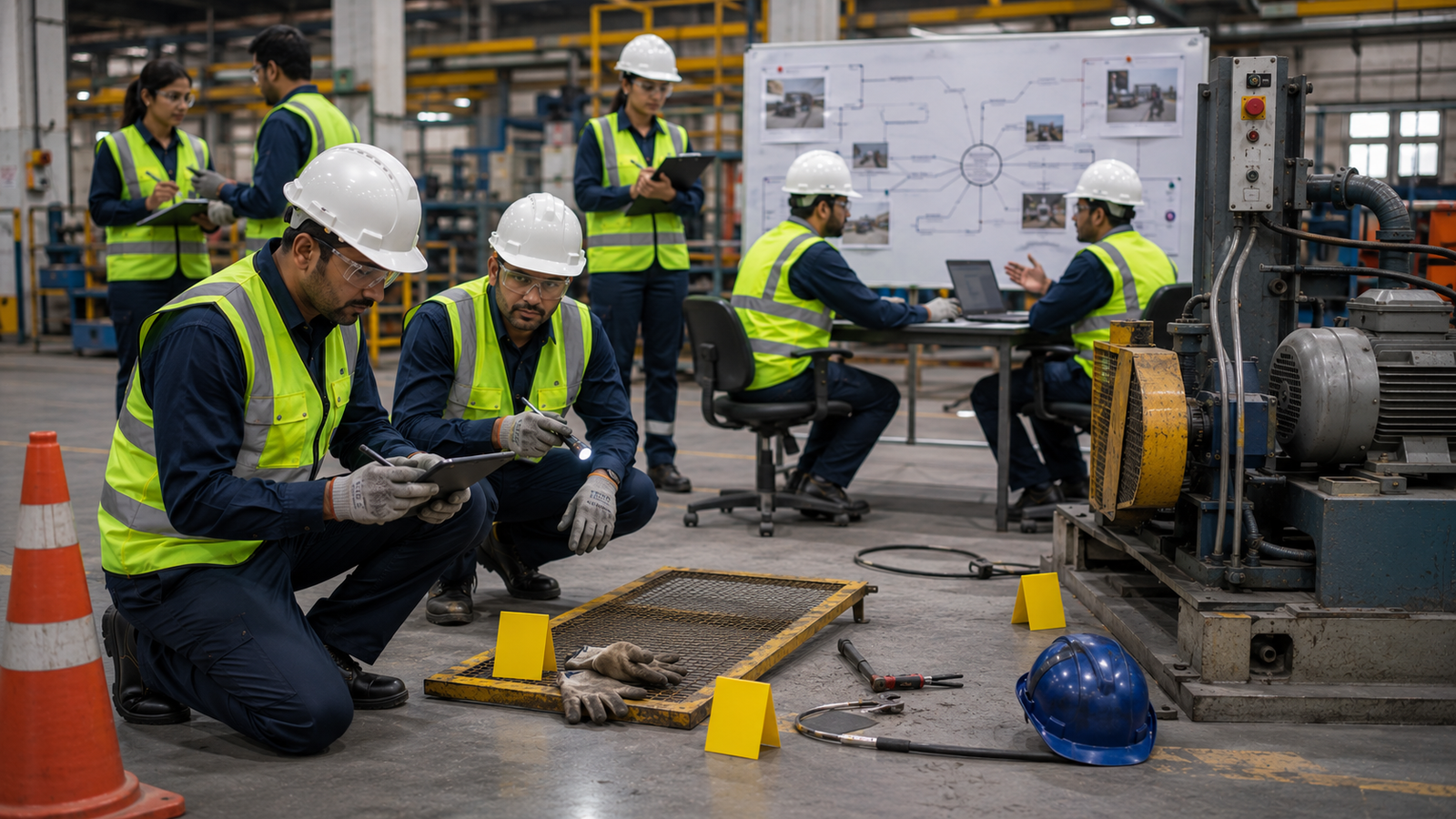
05. Accident Analysis
Participants learn to identify:
01. Recurring accident patterns
02. Common unsafe conditions
03. Unsafe acts and practices
04. Equipment-related issues
05. Training and competency gaps
06. Procedural weaknesses
07. Environmental factors
08. Management and system deficiencies
06. Effective Accident Reporting
A clear investigation report should answer:
01. When — Date and time of the incident
02. Where — Location and work area
03. Who — People involved and witnesses
04. What — Activity or task being performed
05. How — Sequence of events
06. Why — Identified causes and contributing factors
07. What Next — Corrective and preventive actions
07. Learning Outcomes
After completing the course, participants will be able to:
01. Understand the basic principles of accident investigation.
02. Follow a structured investigation process.
03. Collect and preserve relevant evidence.
04. Conduct effective witness interviews.
05. Analyse the sequence of events.
06. Distinguish between immediate, underlying, and root causes.
07. Apply basic root cause analysis techniques.
08. Prepare clear and factual investigation reports.
09. Recommend appropriate corrective and preventive actions.
10. Identify recurring safety issues and trends.
08. Who Can Attend?
01. Safety Officers
02. HSE Professionals
03. Supervisors
04. Managers
05. Fire & Safety Personnel
06. ERT Members
07. Incident Investigators
08. HR & Compliance Teams
09. Industrial Personnel
10. Safety Representatives
11. Students & Safety Trainees
09. Training Approach
Learn → Observe → Investigate → Analyse → Report → Prevent
The training combines essential concepts, practical investigation methods, case studies, incident scenarios, and reporting exercises.
10. Investigation Framework
A Structured Approach to Accident Investigation
01. Respond
Make the area safe and address immediate needs.
↓
02. Preserve
Protect the accident scene and relevant evidence.
↓
03. Investigate
Collect facts, conduct interviews, and examine available evidence.
↓
04. Analyse
Identify immediate, contributing, underlying, and root causes.
↓
05. Report
Document findings and conclusions objectively.
↓
06. Correct
Recommend appropriate corrective and preventive actions.
↓
07. Prevent
Apply lessons learned to reduce the possibility of recurrence.
11. Why Accident Investigation Matters
Effective accident investigation helps organisations:
01. Understand what happened.
02. Identify why it happened.
03. Address weaknesses and unsafe conditions.
04. Improve safety procedures and systems.
05. Prevent similar incidents in the future.
Learn From Incidents. Identify the Causes. Prevent Recurrence.
Accident Investigation, Reporting & Analysis
Systematic Investigation. Clear Reporting. Effective Prevention.