
Heavy Lifting & Rigging Training
Plan the Lift. Rig It Right. Lift It Safely.
The Heavy Lifting & Rigging Training Course provides essential knowledge and practical awareness for safe lifting and rigging operations. Participants learn load assessment, rigging equipment, lift planning, equipment inspection, signalling, exclusion zones and safe load handling.
1. What You’ll Learn
1.1 Load Assessment
Load weight and dimensions
Centre of gravity and balance
Lifting points
Load characteristics
1.2 Rigging Equipment
Slings and shackles
Hooks and lifting points
Spreader beams
Common lifting accessories
1.3 Lift Planning
Lift preparation
Hazard identification
Equipment selection
Work-zone requirements
1.4 Rigging Techniques
Load attachment
Basic rigging configurations
Securing and controlling loads
Safe de-rigging practices
1.5 Lifting Capacity
Working Load Limit (WLL)
Equipment capacity
Sling configurations and angles
Manufacturer requirements
1.6 Signalling & Communication
Designated signaler responsibilities
Standard hand signals
Radio communication
Operator and lifting-team coordination
2. Key Training Areas
Heavy-lifting principles
Load weight and centre of gravity
Slings and lifting accessories
Hooks and shackles
Rigging configurations
Working Load Limit awareness
Sling angles and load distribution
Lifting capacity
Lift planning and risk assessment
Rigging equipment inspection
Exclusion zones
Signalling and communication
Safe load attachment
Suspended-load hazards
Environmental conditions
Overhead electrical hazards
Post-lift inspection and reporting
3. Practical Rigging Training
Learn to Rig Before You Lift
3.1 Assess the Load
Determine load weight and dimensions
Identify lifting points
Consider centre of gravity and balance
Identify potential hazards
3.2 Select Equipment
Select suitable slings and shackles
Check hooks and lifting accessories
Confirm equipment suitability and capacity
3.3 Inspect Rigging
Check for visible damage and wear
Check identification and capacity markings
Identify deformation, corrosion and other defects
3.4 Rig the Load
Apply suitable rigging arrangements
Attach the load correctly
Secure the load under competent supervision
3.5 Establish the Lift Zone
Set exclusion zones
Barricade hazardous areas
Control access and personnel movement
3.6 Communicate
Confirm signals and communication methods
Coordinate the rigger, signaler and crane operator
3.7 Execute the Lift
Follow the approved lifting procedure
Monitor load movement and surrounding conditions
Stop the operation if unsafe conditions develop
3.8 Release & Secure
Land the load safely
De-rig the equipment
Secure and store lifting accessories
Complete post-lift checks
4. Load & Rigging Fundamentals
Understand the Load Before You Lift
01. LOAD WEIGHT
Confirm the load weight before selecting equipment.
02. CENTRE OF GRAVITY
Understand how balance affects load stability.
03. SLING ANGLES
Recognise how sling configuration and angles affect forces.
04. CONNECTIONS
Use suitable lifting points, hooks, shackles and connections.
05. CAPACITY
Never exceed the rated capacity or applicable WLL.
06. LOAD CONTROL
Keep personnel away from suspended and uncontrolled loads.
5. Rigging Equipment Inspection
Inspect Before Every Lift
Check for:
Cuts, tears, burns or severe abrasion
Damaged or deformed shackles
Defective hooks or safety latches
Bent or distorted accessories
Damaged wire ropes
Missing identification or capacity markings
Corrosion or excessive wear
Unauthorised modifications
Damaged lifting points
Equipment unsuitable for the intended lift
Unsafe Rigging Equipment Must Be Removed From Service.
6. Signalling & Communication
One Lift. One Team. One Clear Communication System.
01. Designated Signaler
Use an appropriately designated person to coordinate signals.
02. Standard Signals
Use agreed hand signals or approved communication methods.
03. Radio Communication
Use clear and disciplined radio communication where required.
04. Visibility
Maintain appropriate communication and visibility between team members.
05. STOP Signal
Ensure stop instructions are understood and acted upon immediately.
7. Suspended Load Safety
Never Stand Under a Suspended Load
Participants learn to:
Establish exclusion zones
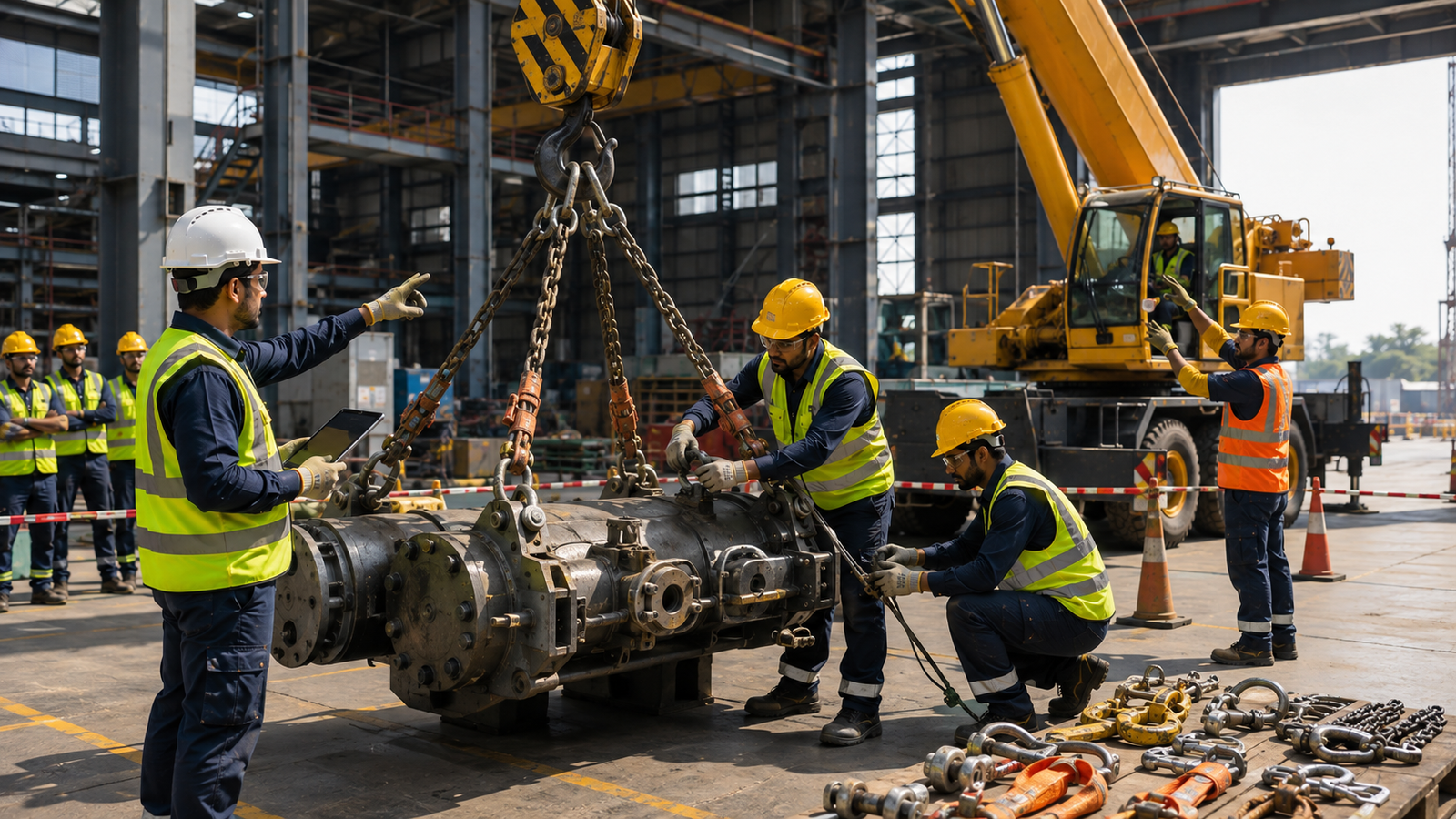
Barricade lifting areasPrevent unauthorised access
Keep personnel away from suspended loads
Control pedestrian movement
Prevent uncontrolled load swing
Maintain safe clearances
Monitor changing site conditions
8. Heavy Lift Planning
Every Heavy Lift Starts With a Plan
Consider:
01. Load Information
Weight, dimensions, centre of gravity and lifting points.
02. Equipment
Crane capacity, rigging equipment and configuration.
03. Location
Ground conditions, access, overhead hazards and surrounding structures.
04. Environment
Wind, weather, visibility and lighting.
05. Personnel
Operator, rigger, signaler, supervisor and other relevant personnel.
06. Controls
Exclusion zones, communication, emergency arrangements and safe work procedures.
9. Emergency Response
Be Prepared Before the Lift Begins
9.1 Load Instability
Stop the operation and follow established emergency procedures.
9.2 Rigging Failure
Maintain the exclusion zone and initiate the appropriate response.
9.3 Equipment Failure
Stop work, secure the area and report the equipment condition.
9.4 Electrical Contact
Follow site emergency procedures and maintain safe distances.
9.5 Severe Weather
Suspend lifting operations when environmental conditions become unsafe.
10. Learning Outcomes
After completing the course, participants will be able to:
Understand fundamental lifting and rigging principles.
Identify common lifting and rigging hazards.
Understand basic load assessment requirements.
Recognise centre-of-gravity and load-balance considerations.
Identify common lifting accessories and their applications.
Understand WLL and equipment-capacity concepts.
Conduct basic visual inspections of rigging equipment.
Recognise damaged or unsuitable lifting accessories.
Understand basic rigging configurations.
Support safe load attachment and control.
Maintain appropriate lifting-zone controls.
Use suitable signalling and communication practices.
Understand basic lift-planning requirements.
Recognise suspended-load hazards.
Follow established emergency procedures.
Contribute to safer lifting operations.
11. Who Should Attend?
Suitable for:
Riggers
Banksmen / Signalers
Crane Operators
Lifting Supervisors
Safety Officers
Construction Workers
Site Supervisors
Engineers
Heavy-Lift Personnel
Maintenance Teams
Contractors
Project Managers
Lifting Team Members
Safety Trainees
12. Training Approach
Understand → Assess → Select → Rig → Communicate → Lift → Inspect
The programme combines:
01. Classroom Learning
Basic lifting and rigging principles.
02. Practical Demonstrations
Rigging equipment and safe load-handling practices.
03. Rigging Exercises
Basic load attachment and rigging arrangements.
04. Equipment Inspection
Identification of damage, wear and unsuitable equipment.
05. Lifting Scenarios
Practical hazard-identification and team exercises.
Practical lifting and rigging activities should be conducted using suitable equipment and under the supervision of appropriately competent and authorised personnel.
13. Safe Rigging & Lifting Cycle
From Planning to Safe Completion
01. PLAN
Understand the load, equipment, location and hazards.
02. ASSESS
Consider weight, centre of gravity, capacity and stability.
03. SELECT
Choose suitable lifting equipment and accessories.
04. INSPECT
Check all rigging equipment before use.
05. RIG
Attach and secure the load using an appropriate arrangement.
06. CONTROL
Establish exclusion zones and control access.
07. COMMUNICATE
Confirm roles, signals and communication methods.
08. LIFT
Execute the lift according to the approved procedure.
09. COMPLETE
Land and secure the load, de-rig equipment and report relevant issues.
14. Key Benefits
For Riggers
Improve rigging awareness, equipment knowledge and load-handling practices.
For Signalers
Improve signalling, communication and lifting-team coordination.
For Supervisors
Strengthen lift planning, hazard control and monitoring.
For Organisations
Support safer lifting operations and reduce exposure to suspended-load hazards.
15. Why Heavy Lifting & Rigging Training Matters
Heavy lifting involves significant forces, suspended loads, specialised equipment and coordinated teamwork.
Effective training helps lifting teams:
Understand the load
Select suitable equipment
Inspect rigging equipment
Identify hazards
Communicate effectively
Control the lifting area
Complete the lift safely
Rig It Right. Lift It Safely. Protect Everyone.
Heavy Lifting & Rigging Training
Practical Lifting & Rigging Safety Training
Develop the knowledge and practical awareness required to plan, assess, rig, inspect, communicate and support safe heavy-lifting operations.