
Chemical Safety
Know the Chemical. Control the Hazard. Protect Every Life.
The Chemical Safety Course is designed to provide workers, supervisors, engineers, laboratory personnel, warehouse teams, and safety professionals with practical knowledge for safely handling, storing, transporting, using, and disposing of hazardous chemicals in the workplace.
Participants learn how to identify chemical hazards, understand labels and Safety Data Sheets (SDS), select appropriate PPE, prevent exposure, manage chemical storage, respond to spills, and take appropriate action during chemical emergencies. Through practical demonstrations, realistic workplace scenarios, and interactive exercises, the course builds confidence and promotes a responsible chemical-safety culture.
What You’ll Learn
Chemical Hazard Awareness
Understand the different types of chemical hazards and how they can affect people, equipment, and the environment.
Chemical Labelling
Learn how to recognise important information on chemical labels, warning symbols, hazard statements, and precautionary information.
Safety Data Sheets (SDS)
Understand how to locate and use important information from Safety Data Sheets before working with hazardous chemicals.
Safe Storage
Learn how to store chemicals according to their properties, compatibility, quantity, and workplace requirements.
PPE Selection
Understand how to select suitable protective equipment based on the chemical and task involved.
Spill & Emergency Response
Learn the basic principles of responding to chemical spills, leaks, exposure, and other emergencies.
Key Training Areas
Participants are introduced to:
Chemical safety fundamentals
Chemical hazard identification
Chemical labels and warning symbols
Safety Data Sheets (SDS)
Flammable chemicals
Reactive and unstable chemicals
Toxic substances
Corrosive materials
Chemical vapours and fumes
Exposure routes
Chemical storage
Chemical compatibility
PPE selection and use
Chemical-resistant gloves
Eye and face protection
Respiratory protection awareness
Emergency showers and eyewash awareness
Spill response
Chemical exposure response
Incident and near-miss reporting
Practical Chemical Safety Training
Identify → Understand → Control → Handle → Respond
Participants can gain practical exposure to:
01 — IDENTIFY THE CHEMICAL
Understand what substance is being used and recognise its potential hazards.
02 — READ THE INFORMATION
Review labels and Safety Data Sheets before handling the substance.
03 — ASSESS THE TASK
Consider how the chemical will be used, transferred, stored, or transported.
04 — CONTROL THE EXPOSURE
Apply appropriate engineering and administrative controls before relying on PPE.
05 — USE APPROPRIATE PPE
Select PPE suitable for the chemical, task, and potential exposure.
06 — HANDLE SAFELY
Follow approved procedures for handling, transfer, use, and disposal.
07 — RESPOND TO EMERGENCIES
Know the basic response actions for spills, leaks, exposure, or accidental release.
08 — REPORT & REVIEW
Report incidents and near misses and learn from identified problems.
Chemical Labels & Hazard Communication
If You Can’t Identify the Hazard, Don’t Start the Task.
Participants learn to look for:
Chemical/product name
Hazard pictograms
Signal words
Hazard statements
Precautionary statements
Supplier information
Relevant handling and storage information
Emergency information
Read the Label Before You Handle the Chemical.
Safety Data Sheets (SDS)
The SDS Is Your Safety Information Guide
Participants learn how to locate key information such as:
Identification
What is the product and how is it used?
Hazards
What hazards are associated with the substance?
First Aid
What should be done following exposure?
Fire Fighting
What are the relevant fire hazards and response considerations?
Accidental Release
What precautions apply to spills or leaks?
Handling & Storage
How should the chemical be handled and stored?
Exposure Controls
What controls and PPE may be required?
Disposal
What considerations apply to disposal?
Know Where the SDS Is Before You Need It.
Routes of Chemical Exposure
Understand How Chemicals Can Enter the Body
Participants learn about common exposure routes:
INHALATION
Breathing vapours, gases, fumes, dusts, or aerosols.
INGESTION
Swallowing chemicals through contaminated hands, food, or equipment.
SKIN CONTACT
Exposure through direct contact with contaminated substances or surfaces.
EYE CONTACT
Chemical splashes, vapours, dust, or particles entering the eyes.
INJECTION
Entry through punctures or injuries involving contaminated equipment or materials.
Control the Exposure — Don’t Just Treat the Consequence.
Chemical Storage
Store Chemicals According to Their Hazards
Participants learn the importance of considering:
Chemical compatibility
Flammability
Corrosive properties
Reactivity
Storage temperature
Ventilation
Container condition
Labelling
Quantity
Secondary containment where appropriate
Access control
Emergency access
Ignition-source control
Never Store Chemicals Together Without Considering Compatibility.
Flammable & Combustible Chemicals
Control the Chemical. Control the Ignition Source.
Participants develop awareness of:
Flammable vapours
Ignition sources
Static electricity
Smoking controls
Electrical equipment
Hot surfaces
Safe storage
Spill prevention
Ventilation
Fire protection
Emergency response
A Small Spill Can Create a Large Fire Risk.
Toxic & Hazardous Chemicals
Exposure Prevention Starts Before the Chemical Is Opened
Participants learn the importance of:
KNOW
Understand the chemical’s hazards.
CONTROL
Use appropriate engineering and administrative controls.
PROTECT
Use suitable PPE where required.
MAINTAIN
Keep work areas clean and controlled.
REPORT
Report leaks, exposure, unsafe conditions, and incidents.
Chemical PPE
Depending on the substance and task, PPE may include:
Chemical splash goggles
Face shields
Chemical-resistant gloves
Protective clothing
Chemical-resistant footwear
Appropriate respiratory protection where required
Other task-specific protective equipment
PPE Selection Must Be Based on the Chemical, Exposure Risk, and Task.
Emergency Shower & Eyewash Awareness
Know Where Emergency Equipment Is Before an Exposure Occurs
Participants develop awareness of:
Emergency eyewash stations
Safety showers
Emergency communication
- Access to first aid
Decontamination procedures
Emergency routes
Reporting requirements
Emergency Equipment Must Remain Accessible and Ready for Use.
Chemical Spill Response
Stop. Alert. Isolate. Respond. Report.
Participants learn basic spill-response principles:
01 — STOP
Stop the activity if it can be done safely.
↓
02 — ALERT
Notify appropriate personnel according to site procedures.
↓
03 — ISOLATE
Keep unnecessary personnel away from the affected area.
↓
04 — IDENTIFY
Use available labels and SDS information to understand the substance.
↓
05 — RESPOND
Only trained and authorised personnel should conduct spill response using appropriate procedures and equipment.
↓
06 — REPORT
Document and report the incident according to workplace requirements.
Never Attempt a Spill Response Beyond Your Training or Available Protection.
Chemical Exposure Response
Act Quickly — Follow the Established Emergency Procedure
The course introduces awareness of appropriate response principles for:
Eye Exposure
Follow the workplace emergency procedure and use available emergency eyewash facilities where appropriate.
Skin Exposure
Follow established decontamination and emergency procedures.
Inhalation
Move to a safe area when appropriate and seek emergency assistance according to site procedures.
Ingestion
Follow the SDS and established medical/emergency procedures.
Unknown Exposure
Treat the situation as potentially hazardous and seek appropriate emergency support.
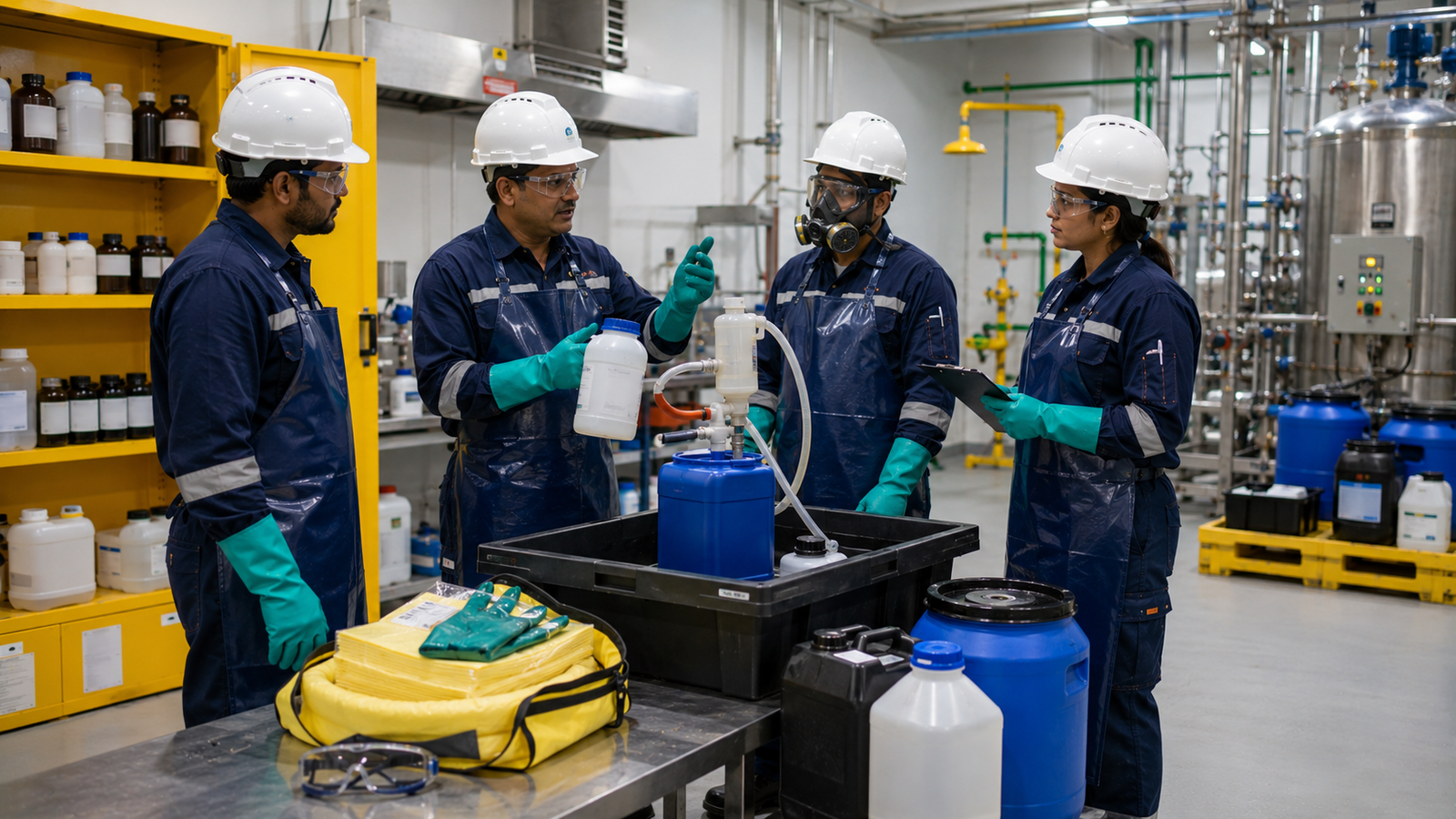
Chemical Transfer & Handling
Control the Chemical From Container to Container
Participants learn to consider:
Correct chemical identification
Suitable containers
Container condition
Labelling
Transfer equipment
Spill prevention
Ventilation
Static-control measures where applicable
Appropriate PPE
Chemical compatibility
Safe disposal
Never Use an Unlabelled Chemical Container.
Chemical Waste Management
Waste Is Still a Hazard
Participants develop awareness of:
Chemical waste identification
Compatible waste containers
Correct labelling
Safe temporary storage
Spill prevention
Segregation
Approved disposal procedures
Environmental protection
Avoiding uncontrolled mixing of chemical wastes
Dispose of Chemical Waste According to Approved Procedures and Applicable Requirements.
Chemical Safety Inspection
Find the Risk Before the Exposure
Participants learn to inspect:
LABELS
Are chemical containers correctly identified?
STORAGE
Are chemicals stored appropriately?
CONTAINERS
Are containers intact and suitable?
SDS
Are relevant Safety Data Sheets available?
PPE
Is appropriate protection available?
EMERGENCY EQUIPMENT
Are emergency showers and eyewash facilities accessible where required?
FIRE CONTROL
Are ignition sources and fire risks appropriately controlled?
HOUSEKEEPING
Are spills, leaks, and contaminated materials controlled?
Learning Outcomes
After completing the course, participants will be able to:
Understand fundamental chemical safety principles.
Identify common chemical hazards.
Recognise different routes of chemical exposure.
Understand chemical labels and hazard communication.
Locate and use important information in Safety Data Sheets.
Understand basic chemical storage principles.
Recognise chemical compatibility concerns.
Apply safer chemical-handling practices.
Select appropriate PPE based on the task and chemical hazard.
Understand basic spill-response principles.
Recognise appropriate actions following chemical exposure.
Understand emergency eyewash and safety-shower awareness.
Recognise chemical-waste handling considerations.
Report chemical incidents, spills, leaks, and near misses.
Contribute to a stronger workplace chemical-safety culture.
Who Can Attend?
This course is suitable for:
Chemical Handlers • Production Workers • Laboratory Personnel • Warehouse Personnel • Maintenance Teams • Engineers • Safety Officers • HSE Professionals • Supervisors • Plant Managers • Facility Teams • Contractors • Industrial Workers
Training Approach
Understand → Identify → Assess → Control → Handle → Respond
The course combines:
Classroom Learning
Fundamental chemical safety concepts and hazard awareness.
Label & SDS Exercises
Practical exercises focused on understanding chemical information.
Hazard Identification
Realistic workplace scenarios involving chemical storage and handling.
Storage Exercises
Understanding compatibility, segregation, and safe storage principles.
PPE Awareness
Selecting appropriate protection based on the chemical and task.
Spill Scenarios
Interactive exercises covering basic emergency-response decision-making.
Chemical Safety Cycle
Know the Chemical Before You Handle It
01 — IDENTIFY
Know what chemical is being used.
↓
02 — UNDERSTAND
Review labels and relevant SDS information.
↓
03 — ASSESS
Understand the hazards and potential exposure routes.
↓
04 — CONTROL
Apply appropriate engineering and administrative controls.
↓
05 — PROTECT
Use suitable PPE where required.
↓
06 — HANDLE
Follow approved handling, transfer, and storage procedures.
↓
07 — RESPOND
Take appropriate action during spills, leaks, or exposure incidents.
↓
08 — REPORT
Report incidents, near misses, and unsafe conditions.
↓
09 — IMPROVE
Learn from experience and strengthen chemical safety practices.
Key Benefits
For Workers
Improve chemical hazard awareness and develop safer handling habits.
For Supervisors
Strengthen chemical-storage monitoring, PPE compliance, emergency preparedness, and workplace safety communication.
For Safety Professionals
Develop stronger awareness of chemical risk identification, control measures, and emergency preparedness.
For Organisations
Support safer chemical handling, reduce exposure risks, strengthen emergency readiness, and promote responsible chemical management.
Why Chemical Safety Matters
Chemicals are essential to many industrial, manufacturing, laboratory, maintenance, and commercial operations. However, improper handling or storage can result in poisoning, burns, fires, explosions, environmental releases, and serious workplace injuries.
Effective chemical safety training helps employees understand the substance, recognise the hazard, control exposure, use appropriate protection, and respond responsibly when something goes wrong.
Know the Chemical. Respect the Hazard. Protect the People.
Chemical Safety
Identify the Hazard. Control the Exposure. Work Safely.
Develop the knowledge and practical awareness required to safely handle, store, use, and respond to hazardous chemicals in the workplace.