
Confined Space Safety & Gas Testing
Test Before Entry. Control the Space. Protect Every Life.
The Confined Space Safety & Gas Testing Course is designed to provide workers, supervisors, safety professionals, maintenance teams, and emergency-response personnel with the knowledge and practical awareness required to safely manage work involving confined spaces.
Participants learn how to identify confined-space hazards, understand atmospheric risks, conduct appropriate gas testing, establish entry controls, use required PPE and safety equipment, maintain communication, and respond effectively to emergencies. Through practical demonstrations, simulated scenarios, and hands-on exercises, the course builds the confidence and discipline needed to prevent serious confined-space incidents.
What You’ll Learn
Confined Space Hazard Awareness
Understand why confined spaces can present unique risks and how hazardous conditions can develop.
Atmospheric Hazard Identification
Learn about oxygen deficiency or enrichment, toxic gases, flammable atmospheres, and other atmospheric hazards.
Gas Testing
Understand the purpose and principles of atmospheric testing before and during confined-space work.
Entry Control
Learn the importance of permits, isolation, access control, communication, and continuous monitoring where required.
PPE & Safety Equipment
Understand the role of appropriate PPE, harnesses, retrieval systems, respiratory protection, lighting, and communication equipment.
Emergency & Rescue
Develop awareness of emergency planning, rescue arrangements, and the importance of never attempting an unplanned rescue.
Key Training Areas
Participants are introduced to:
Confined-space fundamentals
Confined-space hazard identification
Atmospheric hazards
Oxygen deficiency and enrichment
Flammable atmospheres
Toxic gases
Gas-testing principles
Gas detectors and sensors
Bump testing and calibration awareness
Confined-space entry permits
Energy isolation
Mechanical and process isolation
Entry and access control
Communication systems
PPE selection
Harness and retrieval-system awareness
Respiratory protection awareness
Emergency preparedness
Rescue planning
Incident and near-miss reporting
Practical Confined Space Safety Training
Identify → Isolate → Test → Control → Enter → Monitor → Exit
Participants can gain practical exposure to:
01 — IDENTIFY THE SPACE
Determine whether the workplace meets the applicable definition or criteria for a confined space and identify potential hazards.
02 — ASSESS THE HAZARDS
Consider atmospheric, physical, mechanical, chemical, engulfment, access, and other relevant risks.
03 — ISOLATE HAZARDS
Control hazardous energy, process connections, moving equipment, and other potential sources of danger.
04 — TEST THE ATMOSPHERE
Use appropriate gas-testing equipment and procedures to evaluate atmospheric conditions.
05 — ESTABLISH CONTROLS
Implement ventilation, barriers, communication, PPE, rescue arrangements, and other required controls.
06 — AUTHORISE ENTRY
Ensure entry occurs only when the applicable permit and entry requirements have been satisfied.
07 — MONITOR
Continue atmospheric monitoring and maintain communication according to the risk and entry procedure.
08 — EXIT & CLOSE
Ensure all entrants are accounted for and the entry process is formally completed.
Understanding Confined Spaces
A Space Can Look Safe and Still Be Dangerous
Examples may include:
Tanks
Vessels
Silos
Storage bins
Pits
Manholes
Sewers
Trenches
Chambers
Ducts
Pipelines
Boilers
Underground structures
Process equipment
The course emphasises that the classification and entry requirements for a space depend on applicable regulations, workplace procedures, and the specific hazards present.
Atmospheric Hazards
You Cannot Reliably Detect Every Dangerous Atmosphere With Your Senses
Participants learn about:
Oxygen Deficiency
Insufficient oxygen can impair judgement, coordination, consciousness, and survival.
Oxygen Enrichment
Elevated oxygen levels can significantly increase fire and combustion risks.
Flammable Atmospheres
Flammable gases, vapours, or dusts can create fire or explosion hazards when an ignition source is present.
Toxic Gases
Hazardous gases may be present due to process materials, decomposition, cleaning operations, or other sources.
Other Contaminants
Dusts, fumes, vapours, and airborne contaminants may create additional exposure risks.
The Atmosphere Must Be Assessed — Never Assumed Safe.
Gas Testing
Test Before Entry. Test During the Work. Test When Conditions Change.
Participants develop practical awareness of atmospheric testing, including:
PRE-ENTRY TESTING
Test the atmosphere before entry using appropriate equipment and procedures.
↓
MULTI-LEVEL TESTING
Where appropriate, consider that gases and vapours can accumulate at different locations within a space.
↓
RECORD RESULTS
Document readings according to the workplace procedure.
↓
CONFIRM ACCEPTABILITY
Determine whether conditions meet the applicable entry criteria.
↓
CONTINUOUS / PERIODIC MONITORING
Monitor as required by the risk assessment, permit, and entry procedure.
↓
RESPOND TO CHANGES
Stop work and follow emergency procedures if atmospheric conditions become unsafe or alarms activate.
Gas Detector Awareness
The Detector Is a Safety Tool — Not a Substitute for Risk Assessment
Participants learn about the importance of:
Correct instrument selection
Sensor suitability
Pre-use inspection
Battery condition
Bump testing
Calibration
Alarm settings
Sampling methods
Sampling location
Instrument limitations
Recording readings
Maintenance
Proper storage
Use Only Suitable, Properly Maintained, and Appropriately Calibrated Equipment.
What May Be Tested?
Depending on the hazards identified and the instrument being used, atmospheric testing may include:
OXYGEN (O₂)
To identify oxygen-deficient or oxygen-enriched conditions.
FLAMMABLE GASES / VAPOURS
To assess potential flammability hazards.
TOXIC GASES
Where relevant, for example gases identified through the risk assessment or process information.
The Required Gas Tests Must Be Determined by the Specific Space, Hazards, and Applicable Procedure.
Isolation Before Entry
A Confined Space Must Not Become Dangerous Because Another System Starts Operating
Participants learn to consider isolation of:
Electrical energy
Mechanical energy
Hydraulic systems
Pneumatic systems
Pressure
Steam
Hot fluids
Chemicals
Process lines
Moving machinery
Material flow
Other hazardous energy sources
Isolate. Lock. Tag. Verify — According to the Approved Procedure.
Confined Space Entry Permit
No Permit. No Entry — Where a Permit Is Required.
Participants learn about key elements that may be included in an entry permit:
Space identification
Location
Identified hazards
Atmospheric test results
Isolation requirements
PPE requirements
Communication arrangements
Entrant identification
Attendant / standby arrangements
Emergency arrangements
Rescue arrangements
Entry and validity periods
Authorisation
Entry and exit control
Standby / Attendant Awareness
Someone Outside Must Know Who Is Inside and What Is Happening
Where required by the applicable procedure, the attendant or standby person may be responsible for:
Maintaining awareness of entrants
Maintaining communication
Monitoring conditions
Controlling entry and exit
Raising the alarm
Initiating emergency procedures
Preventing unauthorised entry
Supporting the rescue plan
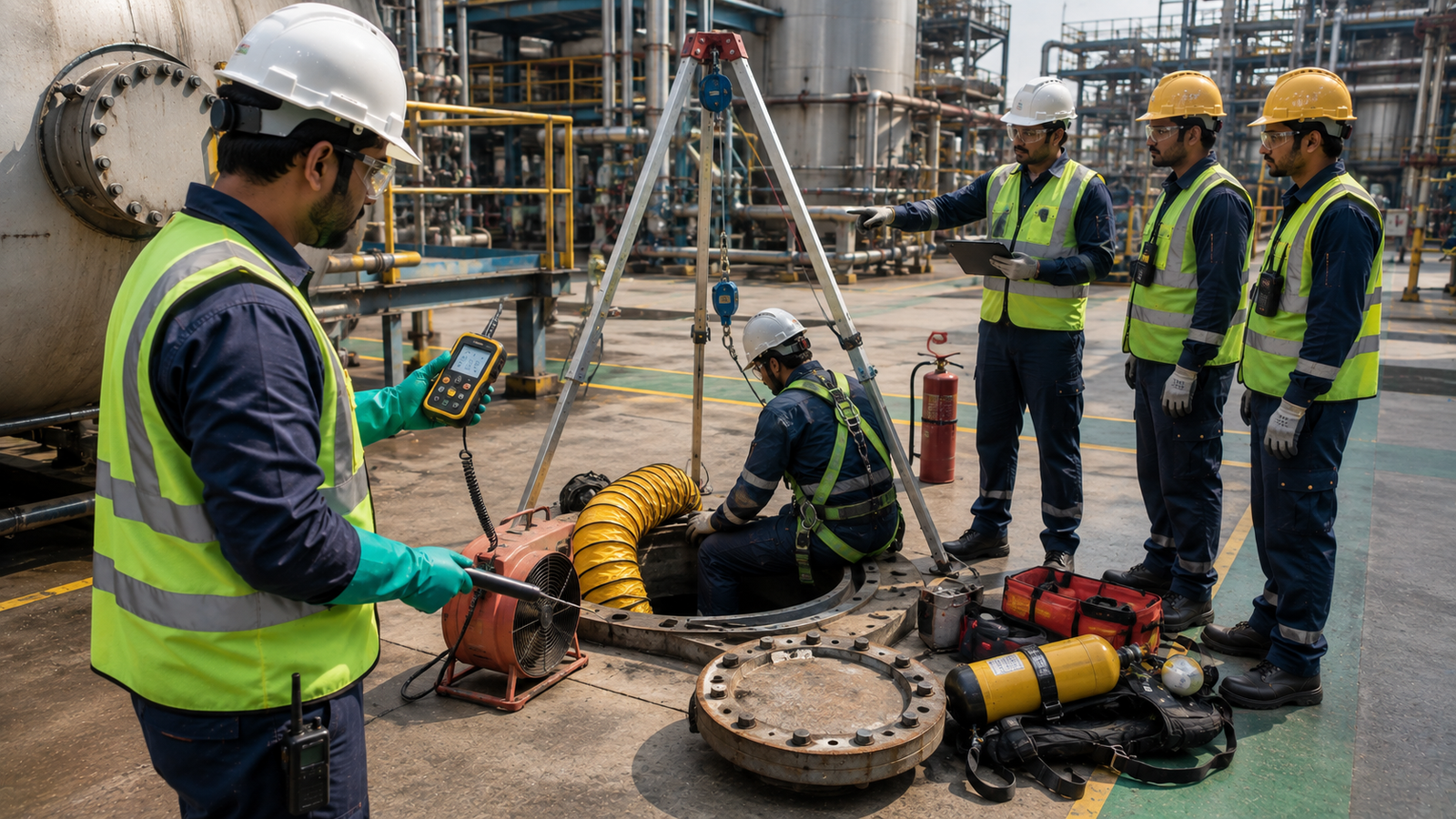
An Attendant Must Never Enter the Space for an Unplanned Rescue.
Communication
Inside a Confined Space, Communication Can Save a Life
Participants learn to consider:
Radios
Voice communication
Signal systems
Visual communication
Emergency alarms
Communication checks
Backup communication methods
Communication arrangements should be established before entry and tested where appropriate.
PPE & Safety Equipment
Depending on the identified hazards, equipment may include:
Safety helmet
Eye protection
Protective gloves
Safety footwear
Protective clothing
Safety harness
Retrieval equipment
Suitable lighting
Communication equipment
Appropriate respiratory protection
Gas detection equipment
Personal alarm devices where appropriate
PPE and Rescue Equipment Must Match the Actual Hazards and Entry Conditions.
Ventilation
Control the Atmosphere Before It Controls You
Participants develop awareness of ventilation as a potential control measure for certain confined-space hazards.
They learn to consider:
Natural ventilation
Mechanical ventilation
Fresh-air supply
Contaminant removal
Ventilation effectiveness
Ventilation equipment
Safe placement of air supply
Avoiding unintended contamination
Ventilation Must Never Be Assumed Effective Without Appropriate Verification.
Emergency Response
Confined-Space Emergencies Require Planning — Not Improvisation
Potential emergencies may include:
TOXIC ATMOSPHERE
Alarm activation, withdrawal, isolation, and emergency response.
LOW OXYGEN
Immediate evacuation and emergency response according to the established procedure.
FIRE / EXPLOSION
Stop work, raise the alarm, evacuate, and activate the emergency plan.
MEDICAL EMERGENCY
Activate the rescue and medical response plan.
EQUIPMENT FAILURE
Stop work and follow the established emergency procedure.
GAS ALARM
Immediately follow the site’s alarm-response and evacuation requirements.
Confined Space Rescue
Rescue Must Be Planned Before Entry
Participants learn the importance of having:
A documented rescue plan
Trained rescue personnel
Suitable rescue equipment
Communication arrangements
Emergency access
Retrieval arrangements
Medical support
Emergency contacts
Defined responsibilities
Periodic rescue preparedness exercises where applicable
Never Create a Second Victim by Attempting an Unplanned Rescue.
Confined Space Safety Inspection
Check the Space Before Anyone Enters
Participants learn to assess:
ACCESS
Can people safely enter and exit?
ATMOSPHERE
Has the atmosphere been appropriately tested?
ISOLATION
Are hazardous energy and process sources controlled?
PERMIT
Are required permits completed and authorised?
COMMUNICATION
Is reliable communication available?
PPE
Is appropriate PPE available and being used?
RESCUE
Are rescue arrangements ready?
EMERGENCY
Is the emergency response plan understood?
Learning Outcomes
After completing the course, participants will be able to:
Understand the fundamentals of confined-space safety.
Recognise common confined-space hazards.
Identify atmospheric risks.
Understand oxygen deficiency and oxygen enrichment hazards.
Recognise flammable and toxic atmospheric conditions.
Understand the purpose and principles of gas testing.
Recognise the importance of suitable gas-detection equipment.
Understand pre-entry and ongoing atmospheric monitoring principles.
Understand basic confined-space permit requirements.
Recognise the importance of energy and process isolation.
Understand ventilation as a potential hazard-control measure.
Recognise appropriate PPE and safety-equipment requirements.
Understand attendant and communication responsibilities.
Appreciate the importance of pre-planned rescue arrangements.
Respond appropriately to gas alarms and changing conditions.
Understand why unplanned entry for rescue can create additional casualties.
Report confined-space incidents, hazards, and near misses.
Who Can Attend?
This course is suitable for:
Confined Space Entrants • Standby / Attendant Personnel • Safety Officers • HSE Professionals • Maintenance Teams • Plant Operators • Engineers • Supervisors • Contractors • Emergency Response Teams • Rescue Teams • Industrial Workers
Training Approach
Learn → Assess → Test → Control → Enter → Monitor → Rescue
The course combines:
Classroom Learning
Core confined-space safety principles.
Hazard Identification
Practical analysis of confined-space scenarios.
Gas Testing Demonstration
Understanding gas-detection equipment, testing principles, readings, alarms, and limitations.
Permit Exercises
Working through confined-space entry requirements.
Isolation Scenarios
Understanding energy and process isolation.
Communication Exercises
Practising effective communication between entrants and standby personnel.
Emergency Scenarios
Interactive discussions around gas alarms, medical emergencies, and rescue situations.
Confined Space Entry Safety Cycle
No Entry Without Control
01 — IDENTIFY
Determine whether the space presents confined-space risks.
↓
02 — ASSESS
Identify atmospheric, physical, chemical, mechanical, and other hazards.
↓
03 — ISOLATE
Control hazardous energy and process connections.
↓
04 — TEST
Assess the atmosphere using appropriate gas-testing equipment.
↓
05 — CONTROL
Establish ventilation, PPE, communication, barriers, and other controls.
↓
06 — AUTHORISE
Complete applicable permit and entry requirements.
↓
07 — ENTER
Enter only when the required controls are in place.
↓
08 — MONITOR
Continue atmospheric and condition monitoring as required.
↓
09 — RESPOND
Stop work and activate emergency procedures if conditions become unsafe.
↓
10 — EXIT
Safely evacuate and account for all personnel.
↓
11 — CLOSE
Complete the entry process, report issues, and review lessons learned.
Key Benefits
For Workers
Develop the knowledge and awareness needed to recognise confined-space hazards and make safer entry decisions.
For Supervisors
Improve permit control, atmospheric monitoring, communication, and entry supervision.
For Safety Professionals
Strengthen confined-space risk assessment, inspection, and emergency preparedness.
For Emergency Teams
Improve awareness of confined-space rescue planning and the dangers of uncontrolled rescue attempts.
For Organisations
Support safer confined-space operations, improve emergency readiness, and reduce the risk of serious incidents.
Why Confined Space Safety Matters
Confined spaces can contain hazards that are invisible, unpredictable, and potentially fatal. A space that appears safe from the outside can quickly become dangerous because of toxic gases, oxygen deficiency, flammable atmospheres, unexpected process releases, engulfment, or other hazards.
Effective training helps workers recognise the risk, test the atmosphere, control hazardous energy, establish entry controls, monitor conditions, and respond appropriately when conditions change.
Test Before Entry. Control the Space. Never Compromise on Life.
Confined Space Safety & Gas Testing
Test. Control. Monitor. Protect.
Develop the practical knowledge and awareness required for safer confined-space entry, atmospheric testing, hazard control, communication, and emergency preparedness.