
Road Safety
Every Journey Matters. Every Road User Matters.
The Road Safety Course is designed to build awareness, responsibility, and safer decision-making among drivers, employees, supervisors, fleet personnel, contractors, pedestrians, and other road users.
The training focuses on understanding road hazards, traffic behaviour, vehicle safety, pedestrian awareness, defensive driving principles, journey planning, fatigue, distractions, weather conditions, and emergency response.
Through practical examples, real-life scenarios, interactive discussions, and safety exercises, participants develop the knowledge and mindset required to reduce road-traffic risks and contribute to a safer road environment.
1. What You’ll Learn
1.1 Road Hazard Awareness
Learn how to identify common road hazards and recognise situations that may lead to incidents.
1.2 Safe Driving Practices
Understand responsible driving behaviour, speed management, lane discipline, and safe vehicle operation.
1.3 Vulnerable Road Users
Develop greater awareness of pedestrians, cyclists, motorcyclists, children, and other vulnerable road users.
1.4 Distraction Prevention
Understand how mobile phones, fatigue, passengers, and other distractions affect road safety.
1.5 Adverse Conditions
Learn how to adapt behaviour during rain, fog, darkness, congestion, and poor road conditions.
1.6 Responsible Road Behaviour
Build a proactive safety mindset that encourages everyone to take responsibility for road safety.
2. Key Training Areas
Participants are introduced to:
Road safety fundamentals
Safe driving behaviour
Hazard perception
Situational awareness
Traffic rules and signals
Speed management
Safe following distance
Lane discipline
Safe overtaking
Intersection safety
Pedestrian safety
Cyclist awareness
Motorcycle safety
Heavy-vehicle awareness
Distracted driving
Fatigue management
Adverse weather driving
Night driving
Highway safety
Urban road safety
Parking and reversing
Seat-belt safety
Vehicle safety
Emergency response
Journey planning
Workplace transport safety
3. The Road Safety Mindset
See → Assess → Anticipate → Act → Arrive Safely
01 — SEE
Observe traffic, road conditions, pedestrians, vehicles, signs, and hazards.
02 — ASSESS
Understand the level of risk around you.
03 — ANTICIPATE
Consider what other road users may do next.
04 — ACT
Choose a safe and controlled response.
05 — ARRIVE
Complete the journey without unnecessary risk.
Safe Roads Begin With Safe Decisions.
4. Hazard Identification
Recognise the Risk Before It Becomes an Incident
Participants learn to identify:
4.1 Pedestrians
Crossing roads, walking near traffic, or entering blind areas.
4.2 Two-Wheelers
Motorcycles and scooters approaching from blind spots or moving between traffic.
4.3 Vehicles
Sudden braking, unsafe overtaking, lane changes, or turning.
4.4 Heavy Vehicles
Blind spots, wide turns, long stopping distances, and restricted visibility.
4.5 Road Conditions
Potholes, debris, uneven surfaces, roadworks, and obstructions.
4.6 Weather
Rain, fog, glare, strong winds, and reduced visibility.
4.7 Intersections
Multiple traffic movements and unexpected road-user behaviour.
5. Traffic Rules & Responsible Road Behaviour
Rules Create Order. Responsibility Creates Safety.
Participants develop awareness of:
Traffic signals
Road signs
Lane markings
Speed restrictions
Right-of-way principles
Safe turning
Overtaking rules
Parking restrictions
Pedestrian crossings
Seat-belt requirements
Helmet requirements where applicable
Safe vehicle positioning
Legal and organisational driving requirements
Follow the Rules — Even When Nobody Is Watching.
6. Speed Management
Control Your Speed. Control Your Risk.
Participants learn how speed affects:
Reaction time
Stopping distance
Vehicle control
Severity of collisions
Visibility
Ability to respond to unexpected hazards
Drivers should always consider:
6.1 Road Conditions
6.2 Weather
6.3 Traffic
6.4 Visibility
6.5 Pedestrians
6.6 Vehicle Type
6.7 Vehicle Load
The Appropriate Speed Is the Speed That Allows You to Maintain Safe Control.
7. Safe Following Distance
Leave Room for the Unexpected
Participants learn to maintain appropriate space based on:
Vehicle speed
Traffic density
Road surface
Weather
Visibility
Vehicle characteristics
Driver condition
Poor Conditions = More Space
Avoid following too closely, particularly when visibility or road grip is reduced.
8. Distracted Road Users
One Distraction Can Change a Journey
Common distractions include:
Mobile phones
Texting
Phone calls
Navigation adjustments
Entertainment systems
Eating and drinking
Passenger interaction
Mental distraction
Fatigue
Eyes on the Road. Hands on the Controls. Mind on Driving.
Participants learn strategies to minimise distractions and maintain attention.
9. Fatigue & Road Safety
Tired Driving Is Risky Driving
Warning signs can include:
Frequent yawning
Heavy eyelids
Difficulty concentrating
Slow reactions
Lane drifting
Missing signs
Reduced awareness
Difficulty remembering recent parts of a journey
Fatigue Management
9.1 REST
Start the journey sufficiently rested.
9.2 BREAK
Take appropriate breaks on longer journeys.
9.3 PLAN
Avoid unnecessary extended driving.
9.4 ROTATE
Use planned driver changes where appropriate.
9.5 STOP
Do not continue when fatigue makes driving unsafe.
10. Road Safety in Adverse Conditions
Change Your Driving When the Environment Changes
10.1 Rain
Reduce speed appropriately, increase following distance, and avoid sudden manoeuvres.
10.2 Fog
Reduce speed, improve visibility where possible, and maintain greater space.
10.3 Darkness
Watch carefully for pedestrians, cyclists, unlit vehicles, and reduced visibility.
10.4 Strong Winds
Maintain vehicle control and take extra care around large vehicles.
10.5 Poor Road Surface
Reduce speed and remain alert for potholes, debris, uneven surfaces, and temporary hazards.
When Visibility Drops, Risk Awareness Must Rise.
11. Pedestrian Safety
Protect the Most Vulnerable Road Users
Drivers and workers should remain alert for:
Pedestrians crossing unexpectedly
People near entrances and exits
Workers in traffic areas
Children
Elderly pedestrians
People with limited mobility
Pedestrians in poorly lit areas
People walking near parked vehicles
Never Assume a Pedestrian Has Seen You.
12. Motorcycle & Two-Wheeler Safety
Two-wheelers can be difficult to see and may move through traffic differently from larger vehicles.
Participants learn to:
Check blind spots carefully.
Allow appropriate clearance.
Avoid sudden lane changes.
Use indicators correctly.
Anticipate two-wheeler movement.
Take extra care at intersections.
Avoid aggressive driving around motorcycles.
Look Twice. Motorcycles Can Be Easy to Miss.
13. Heavy Vehicle Safety
Respect Blind Spots and Vehicle Limitations
Participants learn awareness of:
Large blind spots
Wide turns
Long stopping distances
Limited rear visibility
Slow acceleration
Trailer movement
Loading and unloading areas
Give Large Vehicles Space.
14. Highway Road Safety
Stay Predictable. Stay Focused.
Key practices include:
Maintain safe following distance.
Follow lane discipline.
Avoid unnecessary lane changes.
Use indicators correctly.
Check blind spots.
Overtake only when safe.
- Maintain appropriate speed.
Take fatigue seriously.
Remain alert to roadside hazards.
Predictable Driving Helps Prevent Unexpected Situations.
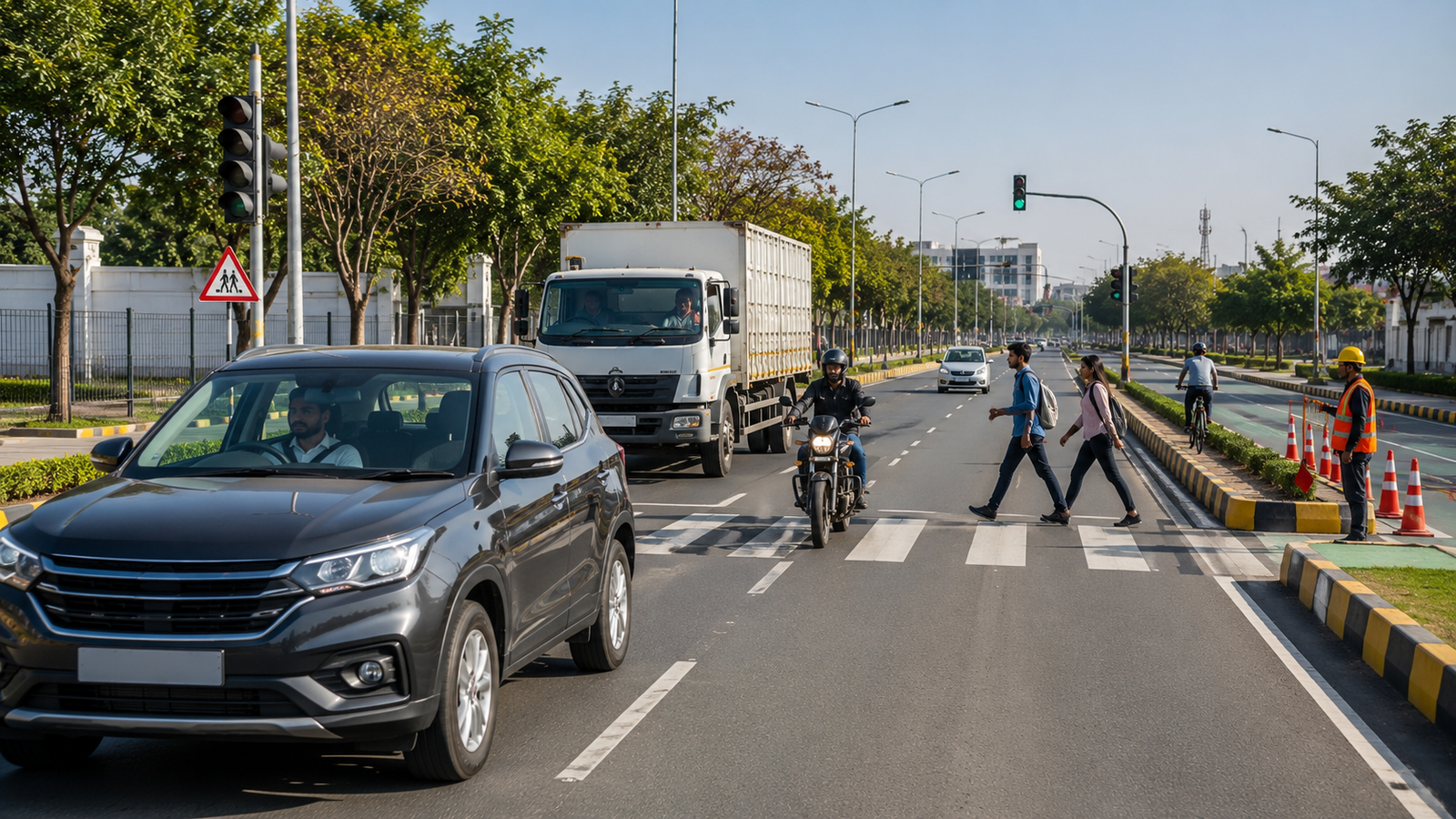
15. Urban Road Safety
Urban roads may involve:
Heavy traffic
Pedestrians
Motorcycles
Buses
Parking activity
Intersections
Roadside vendors
Cyclists
Construction zones
Narrow roads
Slow Down. Scan Continuously. Expect the Unexpected.
16. Parking & Reversing Safety
Most Reversing Incidents Are Preventable
Before reversing:
16.1 CHECK
Inspect the area.
16.2 LOOK
Use mirrors and available visibility aids.
16.3 SCAN
Look for pedestrians and obstacles.
16.4 MOVE SLOWLY
Maintain controlled movement.
16.5 USE A SPOTTER
Where appropriate and required.
16.6 STOP IF UNSURE
Do not continue when the area cannot be safely controlled.
Never Rely Only on Cameras or Sensors.
17. Vehicle Safety
A Safe Journey Starts With a Safe Vehicle
Participants learn basic pre-use awareness of:
17.1 Tyres
Condition and visible damage.
17.2 Brakes
Warning signs or abnormal performance.
17.3 Lights
Headlights, indicators, brake lights, and other required lights.
17.4 Mirrors
Correct adjustment and visibility.
17.5 Seat Belts
Correct use and condition.
17.6 Warning Lights
Recognising dashboard alerts.
17.7 Emergency Equipment
Required equipment based on the vehicle and journey.
Report Defects. Don’t Ignore Them.
18. Seat-Belt & Occupant Safety
Every Seat. Every Journey. Every Time.
Participants learn the importance of:
Correct seat-belt use
Proper seating position
Securing passengers
Avoiding unnecessary movement inside vehicles
Following applicable organisational and legal requirements
The Journey Begins With Buckling Up.
19. Journey Risk Management
Plan the Journey Before Starting the Engine
Consider:
19.1 Route
Identify the route and potential hazards.
19.2 Weather
Consider expected environmental conditions.
19.3 Vehicle
Confirm suitability and safe operating condition.
19.4 Driver
Ensure the driver is fit, alert, authorised, and appropriately licensed.
19.5 Time
Allow enough time to avoid unnecessary driving pressure.
19.6 Fuel / Charging
Plan appropriate stops where needed.
19.7 Rest
Plan breaks for longer journeys.
A Safe Journey Is a Planned Journey.
20. Workplace Road Safety
Road Safety Doesn’t Stop at the Company Gate
Organisations can face road-traffic risks involving:
Employee commuting
Business travel
Company vehicles
Delivery vehicles
Contractor vehicles
Fleet operations
Loading and unloading
Site traffic
Visitor movement
Pedestrian-vehicle interaction
Participants learn how individual actions can contribute to safer workplace transport operations.
21. Workplace Traffic Management
Separate People From Moving Vehicles Wherever Practicable
Key considerations include:
Clearly defined pedestrian routes
Vehicle movement controls
Speed management
Signage
Barricading
Parking controls
Reversing controls
Loading and unloading areas
Visibility
Lighting
Traffic coordination
Good Traffic Management Reduces Conflicts Between People and Vehicles.
22. Road Emergency Response
Know What to Do When an Incident Happens
Participants learn a basic response sequence:
22.1 STOP
Stop safely and prevent additional danger where possible.
↓
22.2 ALERT
Contact appropriate emergency services and responsible personnel.
↓
22.3 SECURE
Take reasonable steps to secure the scene.
↓
22.4 ASSIST
Provide assistance within your training and capability.
↓
22.5 COMMUNICATE
Provide accurate information to responsible persons.
↓
22.6 REPORT
Follow the applicable incident-reporting process.
↓
22.7 LEARN
Support investigation and corrective actions.
Protect Yourself First. Then Help Others Safely.
23. Learning Outcomes
After completing the course, participants will be able to:
Understand the fundamentals of road safety.
Recognise common road hazards.
Improve hazard-perception skills.
Understand responsible road behaviour.
Apply basic defensive-driving principles.
Understand safe speed management.
Maintain appropriate following distances.
Improve awareness of pedestrians and two-wheelers.
Recognise heavy-vehicle hazards.
Understand the risks of distracted driving.
Recognise fatigue-related driving risks.
Adapt behaviour to adverse weather and road conditions.
Improve intersection and highway safety awareness.
Apply safer parking and reversing practices.
Understand basic vehicle safety checks.
Improve journey planning and risk awareness.
Understand workplace traffic hazards.
Respond appropriately to road emergencies.
Contribute to a stronger road-safety culture.
24. Who Can Attend?
This course is suitable for:
Drivers
Fleet Drivers
Professional Drivers
Transport Personnel
Delivery Teams
Logistics Personnel
Employees Who Drive for Work
Supervisors
Managers
Fleet Managers
Safety Professionals
Contractors
Site Personnel
Pedestrians & Workplace Employees
25. Training Approach
Learn → Observe → Anticipate → Respond → Improve
The course combines:
25.1 Classroom Learning
Fundamental road-safety concepts.
25.2 Real-Life Scenarios
Analysis of common road incidents and hazards.
25.3 Hazard-Perception Exercises
Identifying hazards before they become critical.
25.4 Driver Safety Discussions
Practical approaches to everyday road situations.
25.5 Adverse-Condition Scenarios
Understanding rain, darkness, traffic, visibility, and road-condition risks.
25.6 Workplace Transport Scenarios
Understanding vehicle and pedestrian interaction at workplaces.
25.7 Emergency Scenarios
Developing awareness of appropriate actions after a road incident.
26. Road Safety Improvement Cycle
Awareness → Prevention → Protection → Learning
01 — OBSERVE
Continuously scan the road and environment.
↓
02 — IDENTIFY
Recognise hazards and potential conflicts.
↓
03 — ANTICIPATE
Predict possible road-user behaviour.
↓
04 — CREATE SPACE
Maintain safe distance and options.
↓
05 — CONTROL
Manage speed, position, and attention.
↓
06 — RESPOND
Take safe and timely action.
↓
07 — REPORT
Report incidents, hazards, and near misses appropriately.
↓
08 — LEARN
Use lessons to prevent recurrence.
↓
09 — IMPROVE
Continuously strengthen road-safety practices.
27. Key Benefits
27.1 For Drivers
Improve hazard awareness, judgement, attention, and safer driving habits.
27.2 For Employees
Develop awareness of road risks as drivers, passengers, pedestrians, and other road users.
27.3 For Supervisors
Strengthen safe transport practices and road-risk awareness within teams.
27.4 For Fleet Managers
Support safer vehicle operations and driver-management practices.
27.5 For Organisations
Reduce road-traffic exposure, improve workplace transport safety, protect employees and assets, and promote a proactive road-safety culture.
28. Why Road Safety Matters
Road safety is a shared responsibility. Drivers, passengers, pedestrians, cyclists, motorcyclists, employers, contractors, and road authorities all influence the safety of the road environment.
A strong road-safety culture encourages people to recognise hazards, follow safe practices, manage distractions, respect vulnerable road users, maintain vehicles, plan journeys, and make responsible decisions every time they travel.
Every Road. Every Journey. Every Person. Every Time.
Road Safety
Stay Alert. Respect the Road. Protect Every Life.
Build practical awareness of road hazards, responsible road behaviour, vehicle safety, journey planning, workplace transport risks, and emergency response.