
Hazardous Materials Safety
Identify the Hazard. Control the Risk. Handle With Care.
The Hazardous Materials Safety Course is designed to help employees, supervisors, safety professionals, engineers, warehouse teams, maintenance personnel, transport workers, and emergency-response teams understand the risks associated with hazardous materials and develop safer handling practices.
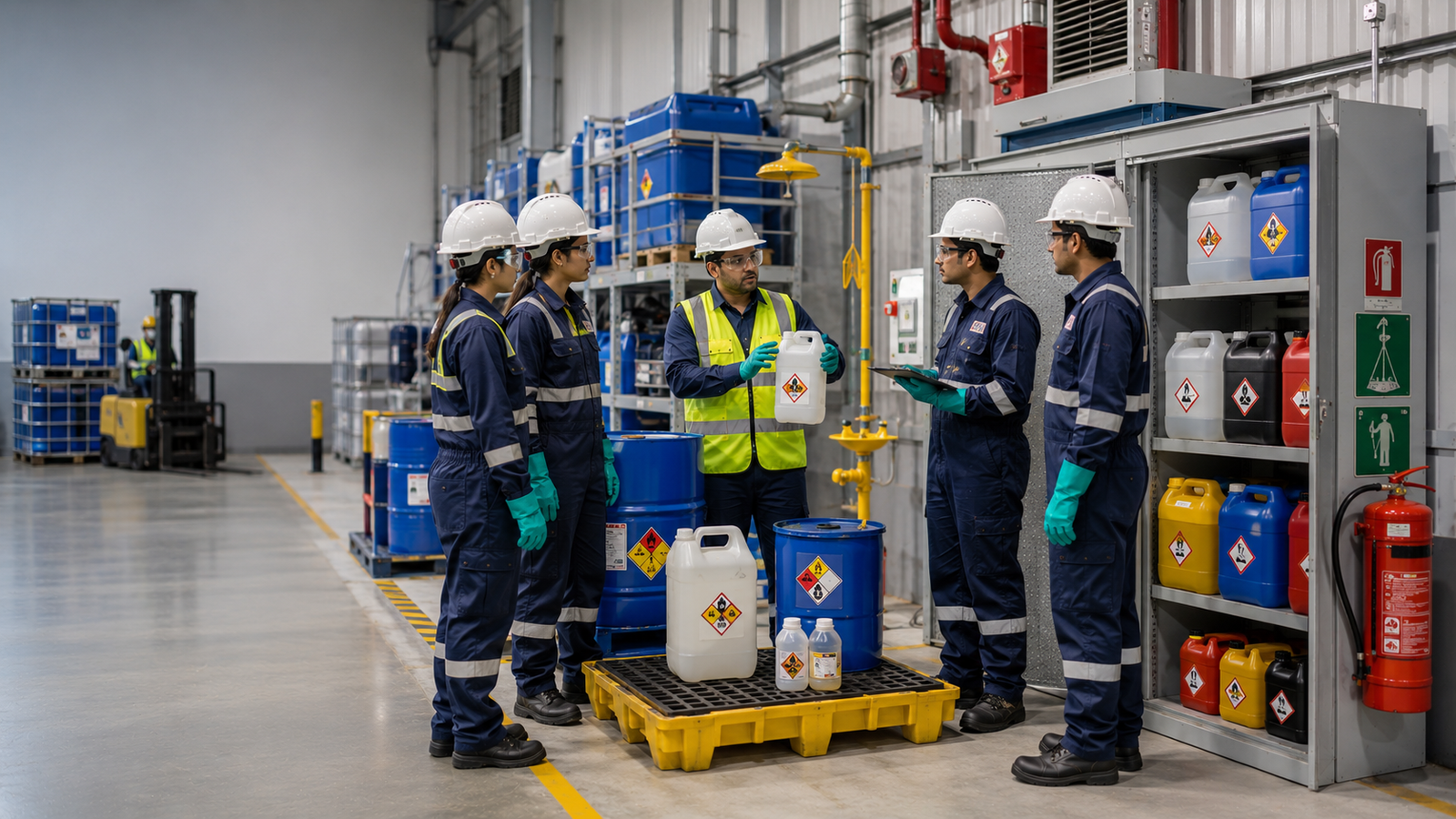
Participants learn how to identify hazardous materials, understand labels and Safety Data Sheets (SDS), select appropriate PPE, store and handle materials safely, prevent exposure and spills, and respond effectively to emergencies.
Through practical examples, workplace scenarios, demonstrations, and interactive exercises, the training develops the knowledge and confidence required to manage hazardous materials responsibly and protect people, property, and the environment.
01. What You’ll Learn
01 — Hazard Identification
Understand how hazardous materials can affect people, property, and the environment.
02 — Labelling & Identification
Learn how labels, hazard symbols, pictograms, and other identification systems communicate risks.
03 — Safety Data Sheets
Understand how to find important information in an SDS and use it during normal work and emergencies.
04 — PPE Selection
Learn how to select and correctly use PPE appropriate to the identified hazards.
05 — Safe Storage & Handling
Understand principles for receiving, storing, transferring, and handling hazardous materials.
06 — Emergency Response
Learn the basic actions required during spills, leaks, exposure, fires, or other hazardous-material emergencies.
02. Key Training Areas
Participants are introduced to:
Hazardous materials fundamentals
Hazard identification
Chemical labels
Hazard pictograms
Safety Data Sheets (SDS)
Chemical properties
Personal Protective Equipment
Exposure awareness
Inhalation hazards
Eye and skin exposure
Flammable materials
Reactive materials
Toxic materials
Corrosive materials
Health hazards
Environmental hazards
Safe storage
Material movement
Container safety
Safe transfer
Fire prevention
Spill prevention
Emergency response
Hazardous-waste awareness
Environmental protection
Documentation and reporting
03. Understanding Hazardous Materials
Know the Material Before You Handle It
Hazardous materials may present different types of hazards.
01 — Flammable
Materials that can ignite and support combustion under applicable conditions.
02 — Corrosive
Materials that can damage skin, eyes, equipment, or other materials.
03 — Toxic
Materials that can cause harmful effects when exposure occurs.
04 — Reactive
Materials that may react dangerously under certain conditions.
05 — Health Hazard
Materials that may cause acute or chronic health effects depending on exposure.
06 — Environmental Hazard
Materials that may cause harmful environmental effects if released.
Different Hazards Require Different Controls.
04. Chemical Labels & Hazard Communication
The Label Is Your First Warning
Participants learn to look for:
Product name
Hazard classification
Hazard pictograms
Signal words where applicable
Hazard statements
Precautionary statements
Supplier information
Storage requirements
Emergency information
Never Use an Unknown or Unlabelled Chemical Without Appropriate Identification and Control.
05. Safety Data Sheet (SDS)
Know Where to Find the Information You Need
Participants learn how to use SDS information to understand:
01 — Identification
What is the material and how is it used?
02 — Hazards
What are the hazards associated with the material?
03 — Precautions
What controls and PPE are required?
04 — First Aid
What actions are recommended following exposure?
05 — Fire Fighting
What hazards and extinguishing considerations apply?
06 — Spill Response
How should accidental releases be controlled?
07 — Handling & Storage
What storage and handling precautions apply?
08 — Exposure Controls
What protective measures are recommended?
09 — Transport Information
What relevant transport information is provided?
Read the SDS Before You Need It.
06. Personal Protective Equipment
PPE Is the Last Line of Defence — Not the Only Control
Depending on the hazard and applicable assessment, PPE may include:
01 — Gloves
Selected for the specific material and task.
02 — Eye Protection
Safety glasses, goggles, or face protection as required.
03 — Face Protection
Face shields where the hazard assessment requires them.
04 — Protective Clothing
Suitable chemical-resistant or protective clothing.
05 — Safety Footwear
Appropriate footwear for the material and work environment.
06 — Respiratory Protection
Used where required and under an appropriate respiratory-protection programme.
The Right PPE Must Match the Hazard.
07. Safe Storage
Store Materials According to Their Hazards
Participants learn the importance of:
Correct labelling
Suitable containers
Appropriate storage areas
Segregation of incompatible materials
Adequate ventilation where required
Spill containment
Secure storage
Temperature control where applicable
Ignition-source control
Routine inspections
Access control
Inventory management
Never Store Hazardous Materials Together Simply Because They Fit on the Same Shelf.
08. Chemical Compatibility
Know What Should Never Be Mixed
Some materials can react dangerously when they come into contact with incompatible substances.
Participants learn awareness of:
Chemical compatibility
Segregation
Oxidisers
Flammable materials
Acids
Alkalis
Reactive materials
Water-reactive materials
Incompatible storage groups
Always Follow the Applicable SDS, Storage Procedure, and Compatibility Guidance.
09. Safe Chemical Handling
Prepare → Check → Handle → Store → Report
01 — IDENTIFY
Confirm the material and its hazards.
02 — CHECK
Review the SDS and applicable work procedure.
03 — PREPARE
Arrange required PPE, equipment, ventilation, and spill controls.
04 — HANDLE
Use appropriate methods and avoid unnecessary exposure.
05 — STORE
Return materials to the correct storage location.
06 — REPORT
Report spills, leaks, damaged containers, exposures, or unsafe conditions.
10. Safe Transfer & Decanting
Control the Material From Container to Container
Participants learn safe principles for applicable transfer activities:
Verify material identity.
Use suitable containers.
Ensure containers are compatible.
Avoid uncontrolled pouring.
Use appropriate transfer equipment.
Control ignition sources where applicable.
Maintain appropriate ventilation.
Prevent spills and splashes.
Use required PPE.
Label secondary containers appropriately.
Return unused material safely.
Never Transfer a Hazardous Material Into an Unidentified Container.
11. Flammable Materials
Control the Fire Triangle
Flammable-material safety focuses on controlling:
01 — FUEL
The flammable material.
02 — OXYGEN
The oxidising environment.
03 — IGNITION SOURCE
Heat, flame, sparks, static, or other ignition sources.
Control Ignition Sources. Control Vapours. Control the Work Area.
Participants learn awareness of:
Ignition-source control
Static electricity
Ventilation
Storage
Safe transfer
Spill prevention
Fire protection
Emergency response
12. Spill Prevention
Prevent First. Contain Quickly.
Common causes of hazardous-material spills may include:
Damaged containers
Poor storage
Incorrect handling
Overfilling
Equipment failure
Improper transfer
Leaking valves
Poor housekeeping
Prevention Measures
Inspect containers
Use suitable storage
Provide containment where required
Use appropriate PPE
Inspect equipment
Maintain good housekeeping
Follow approved procedures
13. Hazardous Material Spill Response
STOP → ALERT → CONTAIN → CONTROL → REPORT
When a spill occurs:
01 — STOP
Stop the activity if it can be done safely.
↓
02 — ALERT
Notify appropriate personnel and activate the applicable emergency procedure.
↓
03 — ISOLATE
Keep people away from the affected area.
↓
04 — CONTAIN
If trained and safe to do so, prevent the material from spreading.
↓
05 — RESPOND
Use appropriate spill-response equipment and procedures.
↓
06 — MANAGE WASTE
Handle contaminated materials according to applicable requirements.
↓
07 — REPORT
Document and report the incident as required.
Never Attempt Spill Cleanup Beyond Your Training, PPE, Equipment, or Emergency-Response Procedures.
14. Exposure Response
Know the First Actions
Potential exposure routes may include:
01 — INHALATION
Breathing hazardous vapours, gases, dusts, or aerosols.
02 — EYE CONTACT
Splash or contact with the eyes.
03 — SKIN CONTACT
Contact with hazardous materials.
04 — INGESTION
Accidental swallowing.
05 — INJECTION
Exposure through puncture or high-pressure systems where applicable.
Participants learn to:
Stop exposure where safe.
Move to a safe area where appropriate.
Follow the SDS and workplace emergency procedure.
Seek appropriate medical assistance.
Report the exposure.
Preserve relevant information about the material.
Always Follow the SDS and Site Emergency Procedure for the Specific Material.
15. Fire Safety Around Hazardous Materials
Participants learn awareness of:
Flammable-material storage
Ignition-source control
Fire detection
Suitable extinguishing arrangements
Emergency access
Evacuation
Fire-response limitations
Emergency communication
Do Not Fight a Chemical Fire Unless You Are Trained, Authorised, and the Situation Is Within the Scope of Your Emergency-Response Procedure.
16. Ventilation & Exposure Control
Control Exposure at the Source
Depending on the material and task, controls may include:
01 — ELIMINATION
Remove unnecessary hazardous materials or activities.
↓
02 — SUBSTITUTION
Use a less hazardous alternative where feasible.
↓
03 — ENGINEERING CONTROLS
Use enclosure, local exhaust ventilation, automation, or other physical controls.
↓
04 — ADMINISTRATIVE CONTROLS
Use procedures, training, scheduling, signage, and access controls.
↓
05 — PPE
Use suitable PPE as the final layer of protection.
Don’t Rely on PPE When the Hazard Can Be Controlled at Its Source.
17. Hazardous Material Waste
Participants learn awareness of:
Waste identification
Waste segregation
Compatible containers
Labelling
Temporary storage
Spill prevention
Waste tracking
Authorised handling
Appropriate disposal
Environmental protection
Waste Must Be Managed According to Its Hazard and Applicable Requirements.
18. Hazardous Material Transportation Awareness
Where hazardous materials are moved within or between facilities, participants learn the importance of:
Correct identification
Appropriate packaging
Secure containers
Labelling
Segregation
Vehicle suitability
Emergency information
Spill-response arrangements
Applicable transport requirements
Safe Transport Begins With Correct Classification, Packaging, Labelling, and Handling.
19. Hazardous Material Inspection
Inspect Before Something Goes Wrong
A workplace inspection may consider:
01 — CONTAINERS
Damage, leakage, condition, and identification.
02 — LABELS
Correct identification and hazard information.
03 — STORAGE
Segregation and compatibility.
04 — CONTAINMENT
Spill-control arrangements.
05 — EMERGENCY EQUIPMENT
Availability and condition.
06 — PPE
Availability, suitability, and condition.
07 — HOUSEKEEPING
Spills, residues, and unnecessary accumulation.
08 — SDS
Availability and accessibility.
20. Hazardous Materials Checklist
Before Handling
Material identified
SDS available
Hazards understood
Required controls identified
Appropriate PPE selected
Container inspected
Label verified
Storage / handling area suitable
Ventilation requirements considered
Spill-control equipment available where required
Emergency arrangements understood
Personnel appropriately trained / authorised
21. Learning Outcomes
After completing the course, participants will be able to:
Understand hazardous-material safety fundamentals.
Identify common hazardous-material hazards.
Recognise hazard labels and pictograms.
Understand the purpose and use of SDS information.
Identify appropriate controls for hazardous-material handling.
Understand basic chemical-storage principles.
Recognise incompatible-material risks.
Understand safe handling and transfer practices.
Select appropriate PPE based on identified hazards.
Recognise common exposure routes.
Understand spill-prevention measures.
Respond appropriately to hazardous-material spills within their training and procedures.
Understand basic exposure-response principles.
Recognise fire risks associated with hazardous materials.
Understand hazardous-waste management awareness.
Support safe transportation and movement of hazardous materials.
Participate effectively in workplace inspections.
Report leaks, spills, exposures, and unsafe conditions.
Contribute to a safer hazardous-material management culture.
22. Who Can Attend?
This course is suitable for:
Safety Officers • HSE Professionals • Chemical Handlers • Warehouse Personnel • Storekeepers • Production Personnel • Maintenance Teams • Laboratory Personnel • Engineers • Supervisors • Managers • Transport Personnel • Emergency Response Teams • Contractors • Workers
23. Training Approach
Identify → Understand → Control → Handle → Respond
The course combines:
01 — Classroom Learning
Fundamentals of hazardous-material safety.
02 — Label & SDS Exercises
Learning how to interpret essential hazard information.
03 — Chemical-Handling Scenarios
Understanding safe storage, transfer, and handling.
04 — PPE Demonstrations
Understanding selection and correct use of protective equipment.
05 — Spill Scenarios
Practising basic response principles within applicable procedures.
06 — Fire-Response Awareness
Understanding hazardous-material fire risks and emergency limitations.
07 — Workplace Case Studies
Applying hazardous-material controls to realistic industrial situations.
24. Hazardous Materials Safety Cycle
Know the Hazard. Control the Exposure. Protect People.
01 — IDENTIFY
Know what material you are working with.
↓
02 — UNDERSTAND
Review labels, SDS information, and applicable procedures.
↓
03 — ASSESS
Understand the hazards and potential exposure.
↓
04 — CONTROL
Establish appropriate engineering, administrative, and PPE controls.
↓
05 — HANDLE
Use safe handling and transfer methods.
↓
06 — MONITOR
Watch for leaks, exposure, unsafe conditions, and changing risks.
↓
07 — RESPOND
Follow emergency procedures when an incident occurs.
↓
08 — REPORT
Report incidents, spills, exposures, and defects.
↓
09 — IMPROVE
Use lessons learned to strengthen controls.
25. Key Benefits
For Workers
Build confidence in identifying, handling, storing, and responding to hazardous materials.
For Supervisors
Improve control of hazardous-material activities and strengthen workplace awareness.
For Safety Professionals
Develop practical knowledge of hazard communication, storage, handling, PPE, and emergency response.
For Warehouse & Logistics Teams
Improve safe storage, movement, identification, and segregation practices.
For Organisations
Support safer chemical and hazardous-material operations, reduce exposure and spill risks, protect employees and the environment, and strengthen emergency preparedness.
26. Why Hazardous Materials Safety Matters
Hazardous materials can create serious risks when they are misidentified, incorrectly stored, improperly handled, or released without adequate controls.
Effective hazardous-material safety starts with understanding the material, identifying its hazards, following the SDS and approved procedures, applying appropriate controls, and knowing what to do when something goes wrong.
Identify the Hazard. Respect the Material. Control the Risk. Protect People and the Environment.
Hazardous Materials Safety
Know the Hazard. Handle Responsibly. Respond Safely.
Develop practical awareness of hazardous-material identification, SDS interpretation, safe storage and handling, PPE, spill prevention, emergency response, and environmental protection.