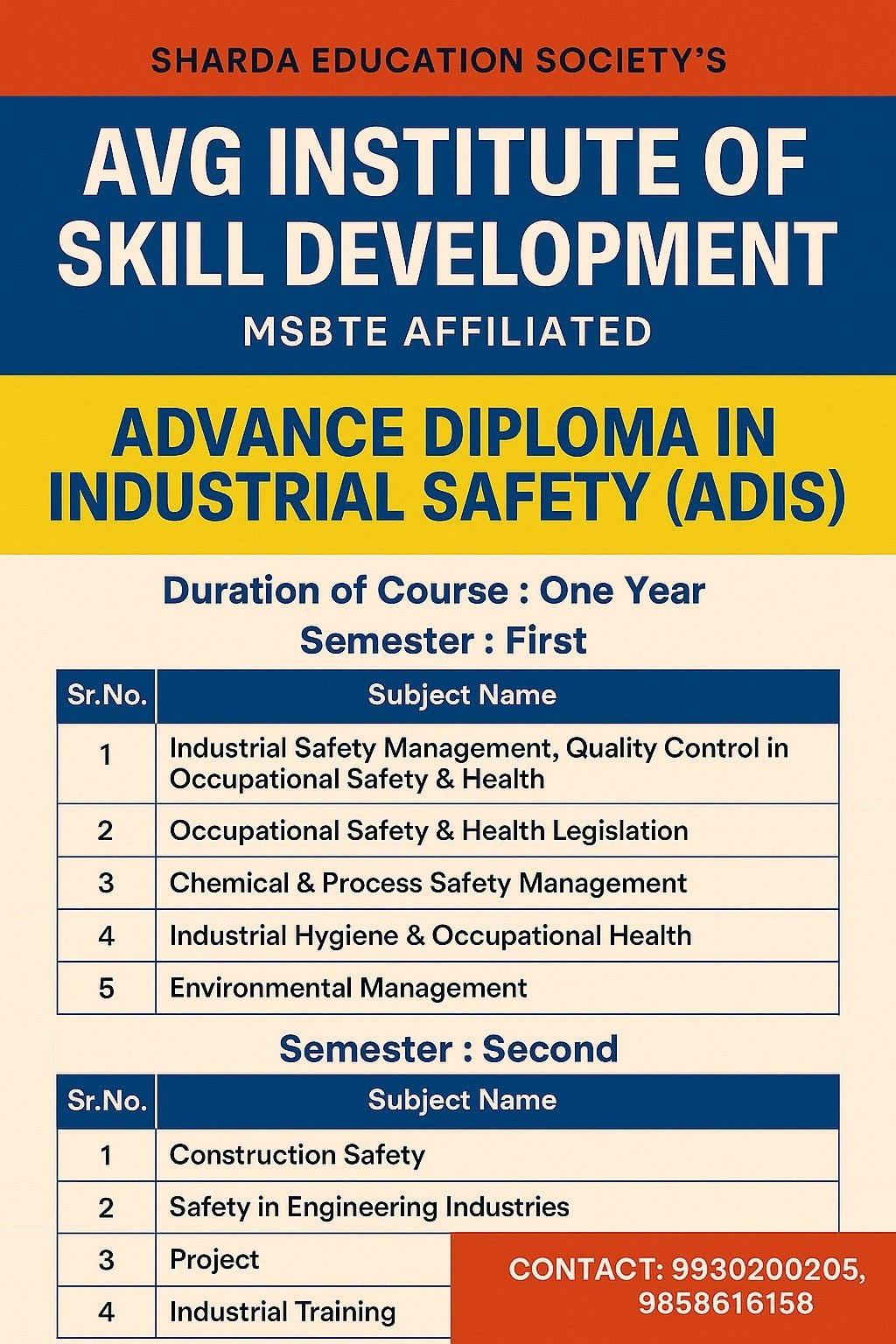
Advanced Diploma in Industrial Safety (ADIS) – 1 Year
Prevent Accidents. Control Risks. Build Safer Workplaces.
The Advanced Diploma in Industrial Safety is a one-year professional program designed to develop advanced knowledge and practical skills in workplace safety, hazard identification, risk assessment, accident prevention, industrial health, emergency preparedness, and safety management.
The program covers industrial safety principles, occupational hazards, risk assessment, personal protective equipment, electrical and mechanical safety, work at height, confined spaces, fire safety, emergency response, accident investigation, and safety management systems.
01. What You’ll Learn
01. Industrial Safety Fundamentals
Principles of industrial safety
Workplace safety responsibilities
Hazard identification and control
Safety procedures and safe work practices
Safety management principles
02. Hazard Identification & Risk Assessment
Workplace hazard identification
Risk assessment techniques
Risk control measures
Job Safety Analysis
Hazard monitoring and reporting
03. Occupational Health & Hygiene
Basic occupational health principles
Workplace exposure hazards
Noise, dust, heat, and chemical exposure
Industrial hygiene awareness
Workplace health protection measures
04. Industrial Equipment & Process Safety
Machinery and equipment safety
Mechanical hazards
Lockout/Tagout awareness
Pressure equipment safety
Process and operational safety
05. Fire & Emergency Safety
Fire prevention principles
Fire protection systems
Emergency response procedures
Evacuation and emergency planning
Disaster preparedness
06. Safety Management & Compliance
Safety inspections and audits
Incident and accident investigation
Safety documentation and reporting
Safety training and communication
Continuous safety improvement
02. Key Industrial Safety Areas
01. Industrial safety fundamentals
02. Hazard identification and risk assessment
03. Job Safety Analysis
04. Occupational health and industrial hygiene
05. Personal protective equipment
06. Electrical safety
07. Mechanical and machinery safety
08. Work-at-height safety
09. Confined space safety
10. Chemical and hazardous material safety
11. Fire and life safety
12. Material handling and lifting safety
13. Construction and maintenance safety
14. Emergency preparedness and response
15. Accident and incident investigation
16. Safety inspection and auditing
03. Practical Industrial Safety Training
Learn to Identify Hazards. Control Risks. Prevent Accidents.
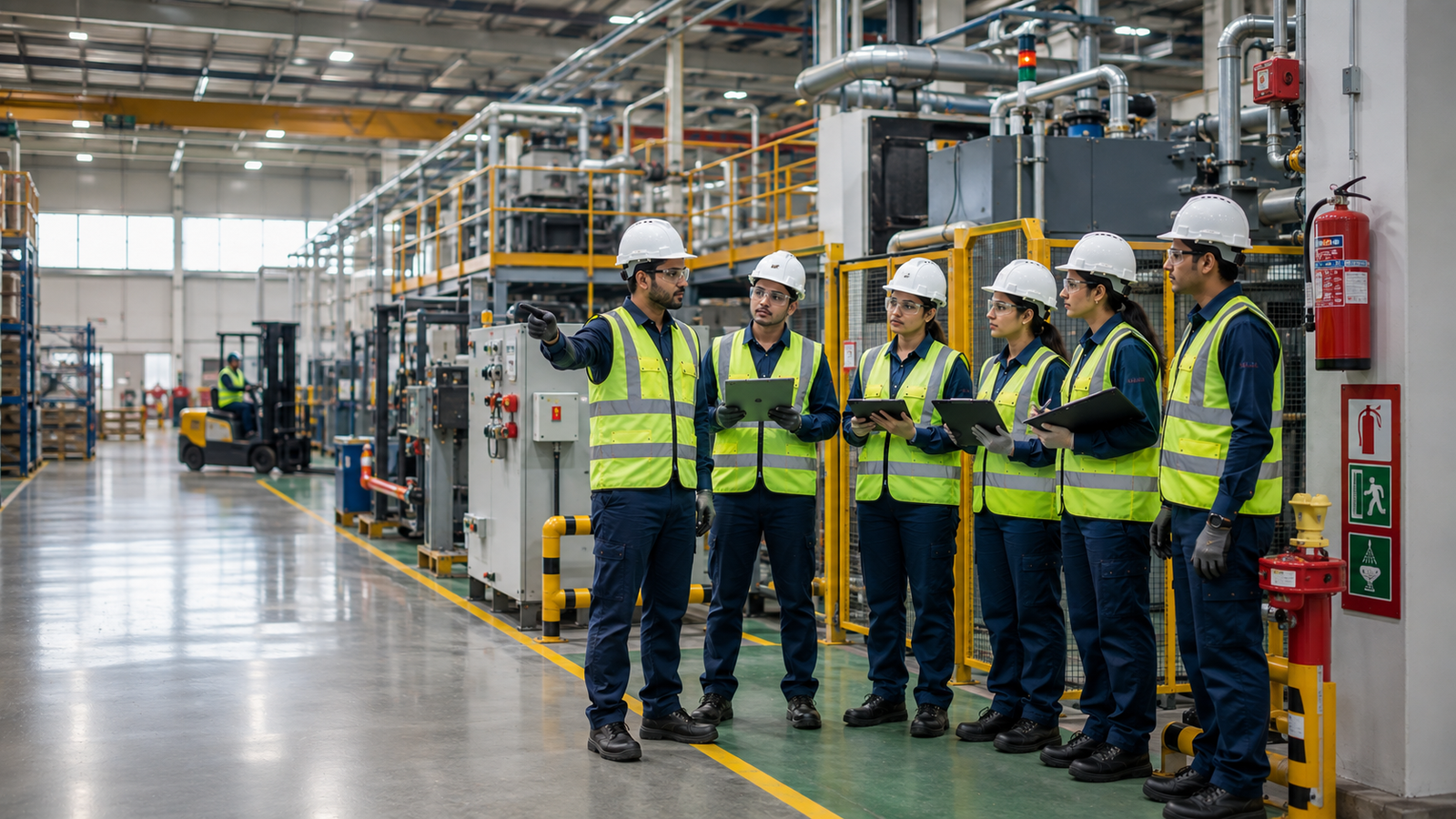
01. Workplace Safety Inspection
Learn how to identify unsafe conditions, unsafe acts, workplace hazards, and areas requiring corrective action.
02. Risk Assessment Exercise
Develop practical awareness of hazard identification, risk evaluation, and selection of appropriate control measures.
03. PPE Demonstration
Understand the selection, inspection, fitting, use, limitations, and care of personal protective equipment.
04. Machinery & Equipment Safety
Learn basic principles for identifying mechanical hazards, machine guarding requirements, safe operation, and maintenance safety.
05. Emergency Response
Understand basic emergency procedures, evacuation arrangements, communication, assembly points, and response responsibilities.
06. Accident Investigation
Learn the basic process of investigating incidents, identifying immediate and underlying causes, documenting findings, and recommending corrective actions.
04. Major Industrial Safety Hazards
01. Mechanical Hazards
Identify risks associated with moving machinery, rotating parts, pinch points, cutting equipment, machine tools, and inadequate guarding.
02. Electrical Hazards
Recognise electrical risks such as damaged cables, exposed conductors, faulty equipment, improper connections, and unsafe electrical practices.
03. Chemical Hazards
Understand risks associated with hazardous chemicals, exposure, storage, handling, labelling, spills, and inadequate control measures.
04. Falls & Work-at-Height Hazards
Identify fall risks associated with ladders, scaffolding, platforms, roofs, elevated work areas, and unsafe access arrangements.
05. Confined Space Hazards
Understand risks associated with restricted spaces, hazardous atmospheres, oxygen deficiency, toxic gases, limited access, and emergency rescue requirements.
06. Fire & Explosion Hazards
Recognise ignition sources, combustible materials, flammable substances, unsafe storage, and other conditions that may contribute to fire or explosion.
05. Learning Outcomes
After completing the course, participants will be able to:
01. Understand advanced principles of industrial safety and workplace risk management.
02. Identify common workplace hazards and evaluate associated risks.
03. Apply basic principles of hazard control and accident prevention.
04. Conduct workplace safety inspections and identify unsafe conditions.
05. Understand the appropriate selection and use of PPE.
06. Recognise electrical, mechanical, chemical, fire, and occupational health hazards.
07. Understand basic emergency preparedness and response procedures.
08. Apply fundamental principles of accident and incident investigation.
09. Understand the role of safety management systems, inspections, audits, and safety documentation.
06. Who Can Attend?
01. Safety Officers
02. Industrial Safety Professionals
03. Safety Supervisors
04. Safety Engineers
05. Industrial Workers
06. Factory Supervisors
07. Maintenance Personnel
08. Facility Managers
09. Production Personnel
10. Emergency Response Teams
11. Safety Trainees
12. Professionals Seeking a Career in Industrial Safety
07. Training Approach
Identify → Assess → Control → Prevent → Respond → Improve
The training combines classroom-based learning with practical demonstrations, workplace inspections, hazard identification exercises, risk assessment activities, safety case studies, emergency scenarios, and interactive safety exercises.
08. Industrial Safety Management Cycle
A Systematic Approach to Workplace Safety
01. Identify
Recognise hazards, unsafe conditions, unsafe acts, and potential sources of harm.
↓
02. Assess
Evaluate the likelihood and potential consequences of identified risks.
↓
03. Control
Apply suitable engineering, administrative, and personal protective measures to reduce risks.
↓
04. Prevent
Establish safe work procedures, training, supervision, and preventive measures.
↓
05. Monitor
Conduct inspections, observations, audits, and ongoing workplace monitoring.
↓
06. Respond
Take appropriate action during incidents, emergencies, unsafe conditions, and abnormal situations.
↓
07. Improve
Learn from incidents, inspections, observations, and audits to continuously strengthen workplace safety.
09. Key Benefits
01. For Students
Develops advanced knowledge of industrial hazards, risk assessment, occupational safety, emergency preparedness, and safety management.
02. For Safety Professionals
Strengthens practical skills in workplace inspections, hazard identification, risk control, incident investigation, and safety management.
03. For Organisations
Supports stronger safety practices, accident prevention, regulatory awareness, emergency preparedness, and workplace risk management.
04. For Industrial Teams
Improves awareness of safe work practices, machinery safety, PPE, emergency procedures, occupational hazards, and risk control.
10. Why Industrial Safety Matters
Industrial workplaces involve machinery, electrical systems, chemicals, processes, vehicles, equipment, and other hazards that can change as work activities and operating conditions change.
Effective industrial safety requires a systematic approach to hazard identification, risk assessment, prevention, control, monitoring, emergency response, and continuous improvement.
The Advanced Diploma in Industrial Safety provides learners with the knowledge and practical awareness required to identify workplace risks, support safety programs, prevent accidents, and contribute to safer industrial operations.
Safer People. Safer Processes. Stronger Industries.
Advanced Diploma in Industrial Safety
Hazard Identification. Risk Control. Accident Prevention. Workplace Safety.