Environmental Management & Legislations
Understand the Law. Control Environmental Risks. Build Sustainable Operations.
The Environmental Management & Legislations Course provides practical awareness of environmental management principles, legal responsibilities, compliance requirements, pollution prevention, waste management, and sustainable workplace practices.
Participants learn how workplace and industrial activities can affect air, water, land, natural resources, and surrounding communities. The course focuses on identifying environmental aspects and impacts, managing waste, preventing pollution, responding to environmental incidents, maintaining compliance records, and supporting continuous environmental improvement.
What You’ll Learn
Environmental Awareness
Understand how workplace activities and industrial operations can affect the environment.
Environmental Legislation
Develop awareness of applicable environmental laws, regulations, permissions, standards, and compliance obligations.
Environmental Aspects & Impacts
Learn how to identify activities that may create environmental impacts and understand their significance.
Pollution Prevention
Understand practical methods for controlling air, water, land, noise, and other forms of pollution.
Waste Management
Learn basic principles of waste segregation, storage, handling, recycling, treatment, and disposal.
Compliance Management
Understand how organisations identify requirements, maintain records, monitor compliance, and address gaps.
Key Training Areas
Participants are introduced to:
Environmental management fundamentals
Environmental protection
Environmental legislation awareness
Environmental compliance
Environmental aspects and impacts
Pollution prevention
Air pollution control
Water and wastewater management
Solid waste management
Hazardous waste awareness
Waste segregation
Noise pollution
Soil and land protection
Chemical and oil spill prevention
Environmental emergency response
Environmental monitoring
Environmental inspections
Compliance audits
Environmental documentation
Resource conservation
Energy efficiency
Water conservation
Sustainable workplace practices
Continuous environmental improvement
Environmental Management Approach
Identify → Assess → Control → Monitor → Improve
Participants learn a practical approach to managing environmental risks:
01 — IDENTIFY
Identify activities, processes, materials, and operations that may interact with the environment.
02 — ASSESS
Evaluate potential environmental impacts and determine their significance.
03 — UNDERSTAND
Identify applicable legal, regulatory, and organisational requirements.
04 — CONTROL
Implement appropriate pollution-prevention and environmental controls.
05 — MONITOR
Track environmental performance, compliance, and control effectiveness.
06 — IMPROVE
Address gaps and implement corrective and preventive actions.
Environmental Legislation Awareness
Compliance Starts With Knowing Your Responsibilities
Participants develop awareness of requirements relating to:
Environmental protection
Pollution control
Waste management
Water and wastewater
Air emissions
Hazardous and other waste
Environmental permissions and authorisations
Monitoring and reporting
Record keeping
Environmental inspections
Incident reporting
Compliance evaluation
India-Focused Awareness
For organisations operating in India, the course can introduce the role of relevant authorities and regulatory frameworks, including MoEFCC, CPCB, SPCBs, and other applicable authorities.
Specific requirements depend on the industry, activity, location, environmental conditions, applicable permissions, and current legislation. Training should therefore be aligned with the latest requirements relevant to the organisation.
Know the Requirement. Understand the Responsibility. Maintain Compliance.
Environmental Aspects & Impacts
Understand How Work Interacts With the Environment
Environmental Aspect
An activity, product, or service that can interact with the environment.
Environmental Impact
A change to the environment resulting from an environmental aspect.
Example
Activity: Chemical storage
↓
Aspect: Potential leakage
↓
Impact: Soil or water contamination
↓
Control: Containment, inspection, appropriate storage, and emergency response
Identify the Aspect. Understand the Impact. Control the Risk.
Air Pollution Management
Control Emissions at the Source
Participants learn awareness of:
Industrial emissions
Dust and particulate matter
Process gases
Combustion emissions
Fugitive emissions
Emission-control systems
Stack monitoring
Preventive maintenance
Good operating practices
Monitor. Maintain. Minimise.
Water & Wastewater Management
Protect Water Resources
Key areas include:
Water consumption
Water conservation
Process wastewater
Domestic wastewater
Effluent treatment
Discharge controls
Leakage prevention
Sampling and monitoring
Water reuse
Recycling opportunities
Documentation and reporting
Reduce Consumption → Prevent Pollution → Treat → Reuse Where Appropriate
Waste Management
Manage Waste From Generation to Disposal
Participants learn the basic waste-management approach:
01 — SEGREGATE
Separate waste according to applicable categories.
02 — STORE
Use suitable, labelled, and controlled storage arrangements.
03 — HANDLE
Prevent spills, leakage, exposure, and incompatible mixing.
04 — RECOVER / RECYCLE
Recover materials where technically and legally appropriate.
05 — DISPOSE
Ensure final disposal follows applicable requirements.
The Right Waste. The Right Method. The Right Control.
Hazardous Waste Awareness
Control Hazardous Waste From Generation to Disposal
Participants learn about:
Identification
Classification
Labelling
Packaging
Storage
Compatibility
Spill prevention
Safe handling
Transportation awareness
Authorised disposal
Documentation
Emergency response
Never Handle or Dispose of Hazardous Waste Without Understanding the Applicable Requirements.
Spill Prevention & Response
Stop the Release. Contain the Impact. Protect the Environment.
Participants learn a basic response sequence:
01 — ALERT
Raise the alarm and notify responsible personnel.
02 — STOP THE SOURCE
If safe and authorised, stop or isolate the source.
03 — CONTAIN
Prevent the material from spreading.
04 — PROTECT
Protect drains, soil, water bodies, and other environmental receptors.
05 — CLEAN UP
Use appropriate response procedures and materials.
06 — MANAGE WASTE
Handle contaminated materials according to applicable requirements.
07 — REPORT
Document the incident and identify corrective actions.
Alert → Stop → Contain → Protect → Clean → Report
Environmental Noise
Control Noise at the Source
Participants develop awareness of:
Industrial noise sources
Equipment and machinery noise
Vehicle movement
Construction activities
Noise-control measures
Monitoring
Maintenance
Barriers and enclosures
Community concerns
Applicable requirements
Identify the Source. Control the Noise. Monitor the Impact.
Environmental Inspection
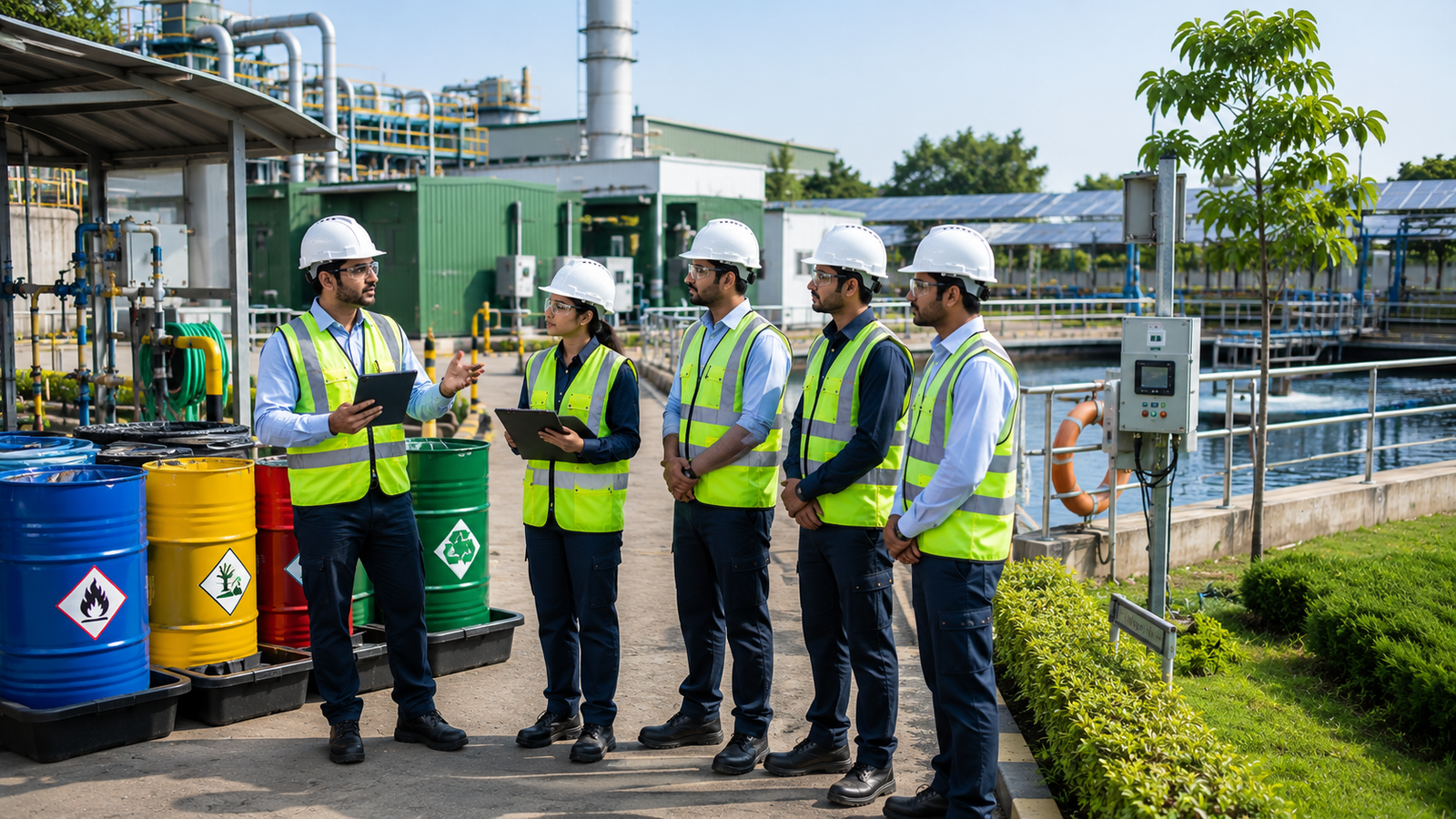
Inspect the Workplace. Identify the Gap. Correct the Cause.
A practical environmental inspection may consider:
WASTE AREAS
Segregation, labelling, storage, housekeeping, and handling.
CHEMICAL STORAGE
Containers, containment, labels, compatibility, and spill controls.
WATER SYSTEMS
Leaks, discharge points, treatment systems, and monitoring.
EMISSION SOURCES
Emission-control systems and operating conditions.
NOISE SOURCES
Equipment, operating conditions, and control measures.
OUTDOOR AREAS
Drainage, contamination, waste, and general environmental conditions.
Environmental Compliance Management
Compliance Is a Continuous Process
01 — IDENTIFY REQUIREMENTS
Determine applicable legal and organisational requirements.
02 — ASSESS COMPLIANCE
Compare current practices against requirements.
03 — DOCUMENT
Maintain appropriate records and evidence.
04 — IDENTIFY GAPS
Recognise non-compliances and improvement opportunities.
05 — CORRECT
Implement appropriate corrective actions.
06 — VERIFY
Confirm that corrective actions are effective.
07 — IMPROVE
Strengthen environmental performance and management practices.
Environmental Documentation
Good Records Support Good Environmental Management
Important records may include:
Environmental monitoring results
Waste records
Waste movement and disposal documentation
Water consumption records
Wastewater monitoring
Emission monitoring
Environmental inspection records
Compliance evaluations
Training records
Environmental incidents
Corrective actions
Permissions and authorisations
Audit findings
Environmental objectives
Environmental performance data
Identify It. Record It. Verify It. Improve It.
Environmental Audit Awareness
Find Gaps Before They Become Bigger Problems
Participants learn the basic audit process:
01 — PLAN
Define scope, criteria, and objectives.
02 — REVIEW
Examine relevant documents and records.
03 — INSPECT
Observe actual workplace conditions.
04 — INTERVIEW
Discuss practices with responsible personnel.
05 — IDENTIFY GAPS
Compare actual practices with applicable requirements.
06 — REPORT
Document findings and observations.
07 — CORRECT
Implement appropriate corrective actions.
08 — FOLLOW UP
Verify completion and effectiveness.
Environmental Emergency Preparedness
Environmental emergencies may include:
Oil or chemical spills
Uncontrolled wastewater discharge
Uncontrolled emissions
Fires involving hazardous materials
Storage-system failures
Contamination of drains or water bodies
Hazardous-waste incidents
Participants learn the importance of:
Emergency procedures
Communication
Spill-control equipment
Containment
Environmental protection
Incident reporting
Corrective actions
Emergency drills
Prepare Before the Incident. Respond Before the Impact Spreads.
Sustainable Workplace Practices
Environmental Responsibility Starts With Everyday Actions
Participants explore practical initiatives involving:
ENERGY
Reduce unnecessary energy consumption.
WATER
Prevent leaks and unnecessary water use.
MATERIALS
Improve material efficiency and reduce waste.
WASTE
Segregate, recover, recycle, and dispose responsibly.
RESOURCES
Use natural resources efficiently.
PAPER
Reduce unnecessary printing and paper consumption.
TRANSPORT
Support efficient transportation practices where practical.
Small Improvements Repeated Every Day Can Create Significant Environmental Benefits.
Learning Outcomes
After completing the course, participants will be able to:
Understand the fundamentals of environmental management.
Recognise how workplace activities affect the environment.
Identify environmental aspects and impacts.
Understand common sources of environmental pollution.
Apply basic pollution-prevention principles.
Understand waste segregation and management practices.
Recognise hazardous-waste handling requirements.
Understand water and wastewater management principles.
Recognise air-emission and noise-control considerations.
Understand the importance of environmental permissions and authorisations.
Support environmental compliance activities.
Participate in environmental inspections and audits.
Maintain appropriate environmental records.
Respond appropriately to environmental incidents.
Identify opportunities for resource conservation.
Support sustainable workplace practices.
Contribute to continuous environmental improvement.
Who Can Attend?
This course is suitable for:
Environmental Officers • HSE Professionals • Safety Officers • Engineers • Supervisors • Managers • Production Personnel • Maintenance Teams • Facility Managers • Contractors • Waste Management Teams • Environmental Committee Members • Workers
Training Approach
Understand → Identify → Comply → Control → Monitor → Improve
The course combines:
Classroom Learning
Environmental management fundamentals and legislative awareness.
Compliance Discussions
Understanding environmental responsibilities and applicable requirements.
Aspect & Impact Exercises
Identifying environmental aspects and potential impacts.
Waste Management Exercises
Practising waste identification, segregation, storage, and control scenarios.
Spill Response Scenarios
Understanding basic environmental emergency response.
Workplace Case Studies
Analysing environmental risks across industrial and workplace environments.
Audit & Inspection Exercises
Identifying compliance gaps and practical improvement opportunities.
Environmental Management Cycle
Identify. Comply. Control. Monitor. Improve.
01 — IDENTIFY
Identify environmental aspects and potential impacts.
↓
02 — ASSESS
Evaluate significance and environmental risks.
↓
03 — UNDERSTAND
Identify applicable legal and organisational requirements.
↓
04 — CONTROL
Implement pollution-prevention and environmental controls.
↓
05 — DOCUMENT
Maintain required records and evidence.
↓
06 — MONITOR
Track environmental performance and compliance.
↓
07 — CORRECT
Address identified gaps and non-conformities.
↓
08 — REVIEW
Evaluate the effectiveness of controls.
↓
09 — IMPROVE
Continuously strengthen environmental performance.
Key Benefits
For Employees
Build environmental awareness and understand responsible workplace practices.
For Supervisors
Improve environmental monitoring, housekeeping, waste control, and compliance awareness.
For Safety & Environmental Professionals
Strengthen environmental aspect identification, compliance monitoring, inspection, and audit skills.
For Managers
Improve environmental responsibility, legal awareness, resource efficiency, and sustainability initiatives.
For Organisations
Support regulatory compliance, pollution prevention, responsible waste management, resource conservation, and continuous environmental improvement.
Why Environmental Management Matters
Every industrial and workplace activity can interact with the environment. Effective environmental management helps organisations understand their impacts, comply with applicable requirements, prevent pollution, manage waste responsibly, and use resources efficiently.
Environmental responsibility goes beyond compliance. It helps organisations build operations that are cleaner, safer, more efficient, and sustainable for the future.
Know the Law. Control the Impact. Protect the Environment.
Environmental Management & Legislations
Comply. Prevent. Protect. Sustain.
Develop practical awareness of environmental management, legal responsibilities, pollution prevention, waste management, compliance, and sustainable workplace practices.